
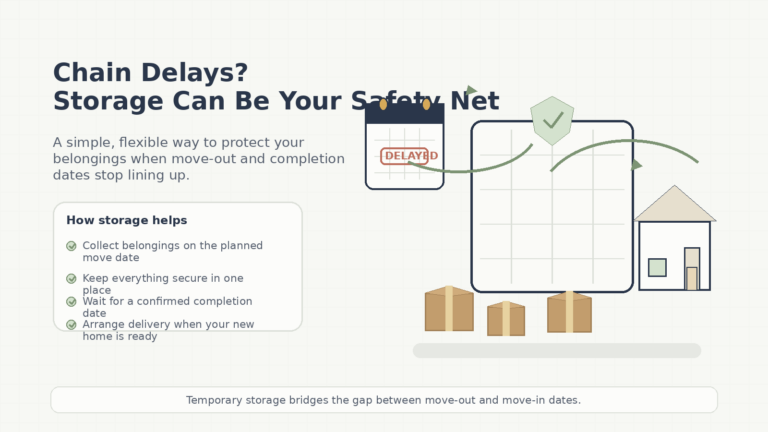
Navigating Chain Delays: How Storage Can Be Your Safety Net
A delayed completion date can quickly disrupt even the best-planned house move. You may need to leave your rental property, hand over keys or meet a removals booking before your new home is ready.
For first-time buyers in Edinburgh, temporary storage can provide a practical safety net. Instead of trying to reorganise the whole move at short notice, your belongings can be collected, protected and stored until you have access to the new property.
This gives you more control over your timeline and helps reduce the risk of rushed decisions, repeated handling or last-minute accommodation problems.
What is a property chain delay?
A property chain is a group of linked home purchases and sales. Each transaction depends on another completing successfully.
A delay can happen when:
- A buyer’s mortgage offer takes longer than expected.
- A survey identifies an issue that needs further investigation.
- Legal searches or paperwork are incomplete.
- One party requests a different completion date.
- Funds are not transferred on schedule.
- A buyer or seller withdraws from the chain.
Some delays are resolved quickly. Others can affect moving plans for days or weeks. The difficulty is that you may not know how long the disruption will last.
Temporary storage options during property chain delays create a gap between moving out and moving in. Your removals team can collect your belongings on the original date, place them into storage and arrange delivery when your new property is ready.
How can storage help during an unexpected chain delay?
Storage separates the movement of your belongings from the legal completion date.
Without storage, you may need to keep changing your removals booking, find space with friends or family, or move everything into temporary accommodation. These options can create extra handling, confusion and stress.
Using storage as a safety net allows you to:
- Leave your current property on schedule.
- Keep furniture and boxes together in one secure location.
- Avoid filling temporary accommodation with non-essential belongings.
- Reduce the number of times items need to be loaded and unloaded.
- Arrange delivery once your completion date is confirmed.
This approach is particularly useful when tenancy end dates, removals bookings and completion dates do not align.
Why storage can be useful for first-time buyers
First-time house buyers in Edinburgh often move from rented flats with fixed notice periods. Your landlord may already have a new tenant due to move in, leaving little room to extend your stay.
You may also be managing several costs at once, including legal fees, deposits, removals and initial work on the new property. A sudden delay can make budgeting and logistics more difficult.
Storage provides a structured fallback plan. It does not remove the uncertainty in the property chain, but it gives you a practical way to manage your belongings while the legal process catches up.
The main advantages include:
- More flexibility: Your belongings can remain stored until you have a confirmed delivery date.
- A clearer moving plan: Collection, storage and redelivery can be discussed in advance.
- Less pressure: You do not need to solve every logistical problem on the day of the delay.
- Better protection: Furniture and boxes can be packed and stored properly rather than placed in unsuitable temporary spaces.
- A simpler temporary move: You can take only the items you need for short-term accommodation.
For a broader look at planning storage around a home move, see our guide to moving house storage.
When should you arrange storage?
You do not always need to book storage at the start of the buying process. However, it is sensible to discuss a backup option when your completion date is uncertain or your moving arrangements are difficult to change.
Consider arranging storage when:
- Your rental tenancy ends close to the expected completion date.
- Several properties are involved in the chain.
- Your seller has not confirmed their onward arrangements.
- You need to book removals before contracts are concluded.
- Your new home needs cleaning, decorating or repairs.
- You have limited space in temporary accommodation.
- Your moving date falls during a busy period.
You should also ask your removals company how much notice it needs to change the plan from direct delivery to storage. Availability can vary, particularly around weekends, school holidays and the end of the month.
Our guide, When Should I Book a House Removal in Edinburgh?, explains how early planning can give you more choice.
A simple storage safety-net plan
You can prepare for a possible delay without assuming that one will happen.
1. Identify your fixed dates
Write down the dates that are difficult to change, including:
- Your tenancy end date.
- Your expected completion date.
- Your removals booking.
- Time off work.
- Temporary accommodation bookings.
- Parking suspensions or access arrangements.
This helps you see where there is little room for delay.
2. Ask about flexible arrangements
When comparing removals and storage quotes, ask what happens if the completion date changes.
Useful questions include:
- Can the collection date remain the same if delivery is delayed?
- Can belongings be moved directly into storage?
- How quickly can redelivery be arranged?
- Is there a minimum storage period?
- What costs may change if the storage period is extended?
- Are collection, handling and redelivery priced separately?
- What level of access is available while items are stored?
Clear answers make it easier to compare services and avoid unexpected charges.
3. Pack a delay essentials kit
Keep the belongings you may need during a short delay separate from the main move.
Your essentials might include:
- Identification and property documents.
- Medication and toiletries.
- Work equipment and chargers.
- Several changes of clothing.
- Basic kitchen items.
- Children’s essentials.
- Pet supplies.
- Valuable or sentimental items.
- Keys and contact details.
Take these items with you rather than placing them into storage.
4. Prepare your belongings for an uncertain timeframe
A delay expected to last two days could become two weeks. Pack as though your belongings may remain stored for longer than planned.
Use sturdy boxes, protect fragile items and label each box clearly. Avoid storing damp items, open food, plants or anything that may deteriorate.
Create a simple inventory so you know what has gone into storage. Numbering the boxes can make items easier to track.
5. Confirm the redelivery process
Ask how delivery will be arranged once your new home is ready.
You may need to confirm:
- The final address.
- Key collection time.
- Parking arrangements.
- Floor level and lift access.
- Narrow stairways or restricted entrances.
- Items that need dismantling or reassembly.
- Your preferred delivery window.
A clear redelivery plan helps the final stage of the move run more smoothly.
Choosing the right type of storage
The right option depends on how much you are storing, how long you may need it and whether you need regular access.
Containerised storage
With containerised storage, your belongings are loaded into storage containers and kept within a storage facility until you are ready for delivery.
This can be convenient during a house move because the same removals provider may be able to manage collection, storage and return. It can also reduce unnecessary handling compared with moving items between several temporary locations.
Ask how your belongings will be loaded, protected and identified, and whether access is available during the storage period.
Self-storage
Self-storage may suit you when you need frequent access to individual items. You usually transport your belongings to the unit and arrange collection when you are ready to move.
Remember to include van hire, fuel, loading time and repeated journeys when comparing the overall cost.
Storage combined with removals
A combined removals and storage service can simplify the process. One team can plan the collection, protect your belongings and arrange redelivery.
This can be particularly helpful when access is difficult or your move involves a traditional Edinburgh tenement.
Choosing the right storage size
The amount of storage you need depends on the volume and shape of your belongings, not only the number of rooms in your current property.
A lightly furnished two-bedroom flat may require less space than a one-bedroom home containing large furniture, sports equipment or many boxes.
To help the provider estimate the right storage capacity:
- List your main furniture.
- Count your approximate number of boxes.
- Mention unusually large or fragile items.
- Explain what can be dismantled.
- Share photos or complete a virtual moving survey.
- Identify items you plan to sell, donate or dispose of.
A realistic inventory can help you avoid paying for unnecessary capacity or discovering that more space is required on collection day.
The planned guide Decluttering With Storage: A Staged Move to Your New Home will also cover how to reduce the volume you need to move and store.
What should you check before choosing a storage provider?
Price matters, but it should not be the only consideration. A clear and reliable service is especially important when your moving date is uncertain.
Ask about:
- How belongings are protected during collection.
- Whether the facility is clean, dry and monitored.
- How containers or stored items are identified.
- What insurance arrangements apply.
- Whether there are restricted or prohibited items.
- Minimum storage periods.
- Charges for collection and redelivery.
- Notice required to retrieve your belongings.
- Procedures for extending the storage period.
- Access arrangements during storage.
Request a written quotation that explains what is included. This makes it easier to compare providers and understand which costs could change if the delay lasts longer than expected.
How much does temporary storage cost?
The cost of storage during a house move depends on several factors:
- The volume of belongings.
- The storage period.
- The collection address.
- Access and parking conditions.
- Packing support.
- The number of team members required.
- Specialist or unusually heavy items.
- Redelivery distance and access.
- How much notice is available.
A quote should distinguish between removals, storage, handling, packing materials and redelivery where relevant.
Avoid relying on a headline storage rate without checking the complete service. A lower weekly rate may not include collection, unloading or return delivery.
Edinburgh access issues to plan for
Moving in Edinburgh can involve practical challenges that affect both time and cost.
These may include:
- Narrow tenement stairwells.
- Upper-floor flats without lifts.
- Controlled parking zones.
- Limited loading space.
- Busy streets and restricted access.
- Large furniture that needs dismantling.
- Shared entrances and closing doors.
- Long carrying distances between the property and vehicle.
Tell your removals provider about these details when requesting a quote. Photos or a virtual survey can help the team understand the property before moving day.
Where parking controls apply, check whether a suspension or permit is required. Arranging this early can help avoid delays during collection or redelivery.
How MoveStore can support a delayed move
When move dates do not align, we can help you plan a combination of removals and storage around your circumstances.
Your belongings can be carefully collected and placed into containerised storage until you are ready for delivery. We will discuss the expected storage period, property access and return arrangements so you understand what happens at each stage.
We can often provide a quotation through a virtual moving survey. This allows us to assess the volume of your move and identify access issues such as stairs, restricted parking or large furniture.
If the completion date changes, contact us as early as possible. We will explain the available options and help you adjust the plan based on storage and team availability.
A moving checklist for possible chain delays
Before moving day:
- Confirm your tenancy end date and likely completion date.
- Ask your solicitor or conveyancer for updates.
- Discuss storage as a backup with your removals provider.
- Request a written breakdown of costs.
- Prepare an inventory of furniture and boxes.
- Separate essential items.
- Confirm parking and access arrangements.
- Keep important documents with you.
- Share any date changes promptly.
If completion is delayed:
- Contact your solicitor, removals provider and accommodation provider.
- Confirm whether collection will still go ahead.
- Check the storage process and expected charges.
- Keep your essentials out of storage.
- Request written confirmation of the revised plan.
- Arrange redelivery once access to the new property is certain.
Plan for uncertainty without expecting the worst
A property chain delay can feel unsettling, particularly during your first house purchase. Having a storage plan gives you a practical response if the dates shift.
You can move out when required, keep your belongings together and arrange delivery once the new home is ready. The key is to discuss the possibility early, understand the costs and choose a provider that communicates clearly.
For a detailed, no-obligation quotation covering removals and flexible storage, get a quote from MoveStore.
Frequently asked questions
How can storage help during an unexpected chain delay?
Storage allows your belongings to be collected even when your new home is not ready. They can remain stored until you have a confirmed completion and delivery date.
What type of storage is best for a first-time buyer?
Containerised storage can work well when you want one provider to manage collection, storage and redelivery. Self-storage may be more suitable when you need frequent access to individual items.
How long can my belongings remain in storage?
The available storage period depends on the provider and your agreement. Ask about minimum terms, extensions and the notice required for redelivery.
Can I access my belongings while they are stored?
Access arrangements vary. Some storage options are designed for regular access, while containerised storage may require advance notice. Check this before booking.
How can I keep my belongings safe in storage?
Use suitable boxes, wrap fragile items and create an inventory. Choose a provider that explains how belongings are handled, identified and stored within its facility.
What should I keep with me during a chain delay?
Keep identification, legal documents, medication, valuables, work equipment, chargers, toiletries and several days of clothing with you. Do not place anything in storage that you may need urgently.