
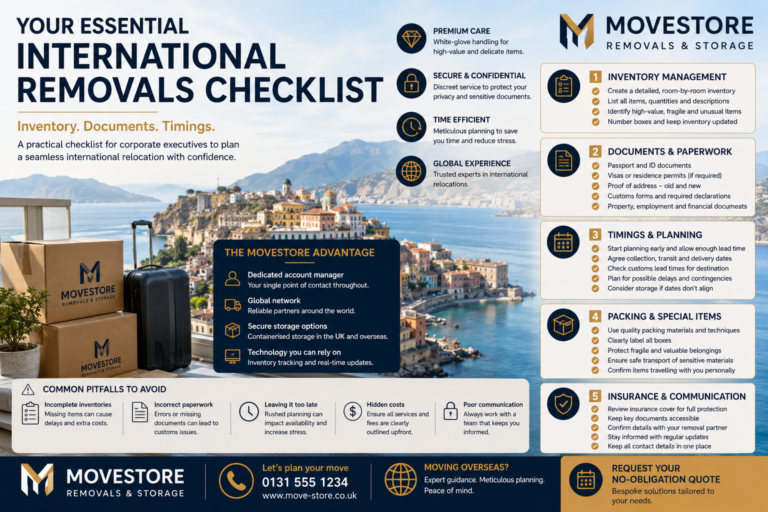
Your Essential International Removals Checklist
An international move involves more than arranging transport and packing boxes. Your inventory, documents, customs requirements, property access and timings all need to work together.
For a busy professional, the simplest approach is to organise the move into three areas: what is moving, what paperwork is required and when each task needs to happen.
Starting early gives you more time to resolve customs questions, identify valuable belongings and make contingency plans if your property or professional schedule changes.
If you’re comparing international removals Edinburgh, use this checklist to prepare for the conversations you should have before booking.
What should an international removals checklist include?
A practical international moving checklist should cover:
- Create a detailed inventory.
- Identify valuable, fragile and unusual belongings.
- Confirm customs and destination-country requirements.
- Gather identity, residence and property documents.
- Agree packing responsibilities.
- Check insurance arrangements.
- Confirm collection and delivery access.
- Establish a realistic moving timeline.
- Plan for possible delays or temporary storage.
- Keep communication and final instructions in one place.
The exact requirements will depend on where you’re moving, but these areas provide a useful framework for most international relocations.
1. Build your international moving inventory
Your inventory is one of the most useful documents in an international move.
It helps you understand exactly what is travelling and gives your removal company clearer information about the volume, packing requirements and any items needing additional attention.
For some destinations, inventory information can also form part of the customs process.
Work room by room
Avoid trying to create the entire list from memory.
Walk through each room and record the main categories of belongings.
For example:
Living room
- Sofa.
- Armchairs.
- Tables.
- Television.
- Artwork.
- Books.
- Lamps.
Bedroom
- Bed and mattress.
- Wardrobes.
- Chest of drawers.
- Clothing.
- Personal belongings.
Home office
- Desk.
- Office chair.
- Monitors.
- Computer equipment.
- Documents.
- Books or professional materials.
Continue the process through kitchens, utility spaces, garages, lofts and storage areas.
This approach reduces the likelihood of larger or less frequently used items being forgotten.
How detailed should an international moving inventory be?
The appropriate level of detail depends partly on your destination and customs requirements.
As a general planning document, descriptions should be useful enough to distinguish groups of belongings.
“Household contents” alone tells you very little.
Descriptions such as:
- Two bedside tables.
- Three cartons of books.
- Kitchenware.
- Clothing.
- Framed artwork.
- Home office equipment.
provide a much clearer picture.
If customs authorities require a particular inventory format, follow the requirements for your destination rather than relying on a generic list.
Create a separate list for high-value belongings
Particularly valuable items deserve individual attention.
This might include:
- Artwork.
- Antiques.
- Watches or jewellery.
- Musical instruments.
- Collections.
- High-value electronics.
- Designer furniture.
- Personal memorabilia.
Discuss these items during your moving survey.
You may need to consider their packing method, handling requirements and the insurance arrangements that apply.
Do not assume that declaring an item on an inventory automatically provides a particular level of cover.
Decide what should not travel with the main removal
An international move can involve periods when your household shipment is inaccessible.
Keep essentials with you.
These may include:
- Passports.
- Visas or residence documents.
- Medication.
- Property paperwork.
- Keys.
- Financial documents.
- Work equipment you need immediately.
- Chargers.
- Important contact details.
- Clothing for the first few days or weeks.
A separate essentials list helps prevent important belongings from being packed accidentally.
2. Gather the documents needed for an international move
Documentation requirements vary considerably between countries.
The paperwork needed for a move within Europe may differ from a relocation further overseas, while customs relief schemes can have their own eligibility conditions.
Start researching the requirements for your specific destination as soon as your relocation is confirmed.
Documents you may need to organise include:
- Passport or identity documents.
- Visa or residence documents where applicable.
- Evidence of your previous address.
- Evidence of your new address.
- Employment or corporate relocation documentation.
- Property purchase or tenancy documents.
- Household inventory.
- Customs declarations.
- Details relating to particularly valuable belongings.
- Vehicle documents if a vehicle is moving with you.
- Relevant insurance documentation.
Your destination country’s authorities determine its formal requirements.
Make sure you understand which documents must be supplied before collection and which need to remain accessible during the journey.
Moving to an EU country after Brexit
A move from Great Britain to an EU member state now involves customs considerations that were not part of the process in the same way before Brexit.
If the EU is your destination, see Moving to the EU After Brexit: What Changes for Removals? for a more focused look at inventories, customs paperwork and transfer-of-residence considerations.
The broader lesson for any international move is to avoid assuming that paperwork can be sorted once your belongings are already packed.
Check destination-specific requirements early.
3. Plan your international moving timeline
There is no single correct timetable for every international move.
Destination, transport method, customs requirements, property dates and the complexity of your household can all affect timings.
Instead of treating a fixed number of weeks as a guarantee, work backwards from your likely moving period.
As soon as the relocation is confirmed
Start with the decisions that influence everything else.
- Confirm your destination.
- Establish your approximate moving period.
- Arrange a moving survey.
- Research immigration and customs requirements.
- Begin your inventory.
- Identify valuable or unusual items.
- Consider whether storage could be useful.
- Clarify any employer relocation requirements.
You do not need every property date to be final before starting these tasks.
Several weeks before collection
By this stage, the move should become more detailed.
Focus on:
- Completing your household inventory.
- Gathering customs paperwork.
- Confirming which belongings will move.
- Decluttering items you do not want to take.
- Agreeing packing arrangements.
- Discussing high-value belongings.
- Reviewing insurance.
- Confirming access information at both properties.
- Checking whether your dates still align.
Notify your removal company promptly if the volume of belongings changes substantially.
In the final weeks
Confirm the operational details.
- Finalise documentation.
- Check passport and travel arrangements.
- Confirm the collection address.
- Confirm destination details.
- Separate belongings travelling with you.
- Finish any self-packing.
- Confirm contact numbers.
- Review storage arrangements if needed.
- Check that particularly important items have been identified.
Avoid creating new paperwork systems at this point. Keep everything in the structure you have already established.
During moving week
Your focus should shift from planning to verification.
Check:
- Final inventory.
- Collection timings.
- Access and parking.
- Documents required for the move.
- Items that must remain with you.
- Destination contact details.
- Delivery instructions.
- Emergency or alternative contacts.
Keep passports, travel papers and other essential documents away from the main packing area.
4. Plan packing around the journey
International removals can involve longer transit periods and more complex transport arrangements than a local move.
Packing therefore needs to reflect the item and journey involved.
Fragile or higher-value belongings should be identified before packing begins.
Depending on the contents, suitable protection may involve:
- Strong removal cartons.
- Packing paper.
- Internal cushioning.
- Furniture covers.
- Protective wrapping.
- Clear labels.
- Additional protection for delicate surfaces.
The important point is that packing should suit the item.
Do not assume one type of wrapping is appropriate for everything.
Label international moving boxes clearly
Good labelling supports both inventory control and unloading.
Useful information can include:
- Room.
- General contents.
- Box number.
- Handling instructions where appropriate.
If you number boxes, those numbers can also correspond with your inventory.
For example:
- Box 01 – kitchenware.
- Box 02 – books.
- Box 03 – bedroom clothing.
You do not need an unnecessarily complicated inventory management system. A consistent numbering method and one central list are often more useful than several competing spreadsheets or apps.
5. Decide how sensitive materials will be handled
A relocating corporate executive may be moving more than ordinary household belongings.
You may have:
- Confidential documents.
- Company-owned devices.
- Financial records.
- Legal paperwork.
- Client information.
- Digital storage devices.
Consider whether these items should form part of the household removal at all.
Your employer may have its own information-security or data-protection policies governing company documents and devices.
Where sensitive records are no longer required, arrange appropriate disposal rather than moving unnecessary confidential paperwork internationally.
Where documents need to remain accessible, keep them with you.
6. Review insurance before collection
Insurance is particularly important when a move includes valuable or unusual possessions.
Before moving day, establish:
- What cover applies.
- Whether individual item limits exist.
- Whether certain belongings need to be declared.
- Whether packing arrangements affect cover.
- What happens during temporary storage.
- Whether any exclusions are relevant to your possessions.
If you have valuable artwork, antiques or collections, raise these specifically rather than assuming they fall under standard arrangements without conditions.
A planned supporting guide, Moving Insurance Explained: Transit Cover, Liability, Valuations, will cover this subject in more detail once published.
7. Build flexibility into an international move
International relocations involve several moving parts.
Your new home may not be available when expected. Customs processing can add dependencies. Professional commitments may change at short notice.
A contingency plan is therefore useful.
Ask yourself:
- Could you stay in temporary accommodation?
- Which belongings do you need immediately?
- Could the remainder go into storage?
- How would a later delivery affect you?
- Who can make decisions if you are travelling for work?
These questions are particularly important for executives who may not be available throughout every stage of the move.
How storage can help
Storage can separate the date you leave your Edinburgh property from the date your overseas property becomes available.
This can be useful when:
- Property dates do not align.
- You are staying in temporary accommodation.
- Your employer needs you to relocate before your household goods.
- Renovation work is underway.
- Access changes unexpectedly.
- You only need part of your household initially.
MoveStore offers containerised storage that can be incorporated into a relocation where appropriate.
Discuss it during planning rather than treating it solely as an emergency measure.
8. Keep communication simple
An international relocation can generate a large number of emails, documents and decisions.
Clear communication makes the process easier to manage.
Before booking, establish:
- Your main point of contact.
- How updates will be provided.
- Who needs to approve changes.
- Which contact details should be used.
- Who can act on your behalf if you are unavailable.
- How amendments to the inventory or schedule should be communicated.
For a corporate relocation, it may also be useful to clarify the relationship between you, your employer and the removal provider.
The goal is not constant communication. It is having the right information reach the right person at the appropriate time.
9. Check access at both properties
International transport may be the most visible part of the move, but ordinary property access can still create significant delays.
For your Edinburgh address, consider:
- Tenement stairs.
- Lift access.
- Controlled parking.
- Narrow streets.
- Carrying distance.
- Loading restrictions.
For your destination, provide equivalent information wherever possible.
A large vehicle may not be able to reach the front door of every overseas property. If smaller vehicles, longer carries or alternative arrangements may be needed, these should be identified in advance.
10. Watch for warning signs when choosing an international removal company
A detailed international removal requires trust.
When comparing providers, be cautious if a company:
- Is unwilling to provide a written quotation.
- Cannot explain what is included.
- Gives little attention to access or inventory.
- Avoids questions about insurance.
- Provides unclear information about international documentation.
- Applies pressure to book immediately.
- Cannot explain who will coordinate the move.
- Gives vague answers about storage or delays.
You should be able to understand how your relocation will be managed before committing.
A clear proposal is especially valuable for a corporate move because it provides a reference point for services, responsibilities and expectations.
Questions to ask before booking
Consider asking:
- Who will coordinate my relocation?
- What information do you need for the inventory?
- Which documents do you require from me?
- What packing services are available?
- How are fragile and high-value items handled?
- What insurance arrangements apply?
- What storage options are available?
- How will schedule changes be managed?
- How will I receive updates?
- What is included in the quotation?
The answers should help you assess the overall process rather than simply compare headline prices.
International removals checklist at a glance
Inventory
- Create a room-by-room list.
- Number boxes consistently.
- Identify high-value belongings.
- Flag fragile or unusual items.
- Separate possessions travelling with you.
- Update the list if your volume changes.
Documents
- Check passport requirements.
- Gather visa or residence documents where relevant.
- Prepare customs paperwork.
- Keep evidence of your old and new addresses.
- Organise property and employment documents.
- Keep essential originals accessible.
Packing
- Confirm who is packing.
- Use appropriate cartons and protection.
- Label boxes clearly.
- Separate sensitive materials.
- Identify specialist items before moving day.
Timings
- Start planning as early as practical.
- Confirm customs requirements early.
- Allow time for packing and documentation.
- Review dates regularly.
- Build in a contingency plan.
- Consider storage if property dates are uncertain.
Final checks
- Confirm access at both properties.
- Review insurance.
- Check contact information.
- Confirm collection arrangements.
- Keep travel documents with you.
- Make sure everyone understands the final plan.
Plan the move around information, not assumptions
The most effective international relocations are organised before moving day.
A reliable inventory tells everyone what is travelling. Complete paperwork reduces uncertainty around customs and transport. A realistic timeline gives you room to deal with changes without trying to solve every problem at the last minute.
For an executive move, that preparation also reduces the amount of personal coordination required once the relocation is underway.
MoveStore can help structure the removal around your destination, household, schedule and storage requirements, with clear planning from the initial survey onwards.
Request a no-obligation quotation to discuss your international move and the level of support you need.
FAQs
What is a good packing list timeline for international removals?
Start your inventory and planning as soon as the relocation is reasonably certain. Packing itself can happen closer to collection, but customs research, inventories and decisions about high-value belongings should not be left until moving week.
How detailed should an inventory list be for overseas shipping?
It should be detailed enough to identify the main categories and quantities of belongings being transported. Your destination’s customs process may require a particular format or greater detail, so always check the applicable requirements.
What documents are required for an international move?
Requirements depend on the destination. Common documents can include passports, residence or visa paperwork, evidence of addresses, household inventories, customs forms and property documentation.
How can I manage my inventory effectively?
Use one central inventory and a consistent numbering system for boxes. Update it when belongings are added or removed rather than maintaining several different versions.
What are red flags when hiring international movers?
Be cautious about unclear quotations, vague insurance information, poor communication and providers that show little interest in your inventory or destination requirements. A reputable process should be explained clearly before you book.
When should I start planning an international relocation?
Start once you know your likely destination and moving period. International moves require more coordination than local removals, particularly where customs documentation or destination-specific rules are involved.
How should I handle sensitive documents?
Keep essential identity, legal and travel documents with you. For employer-owned or confidential materials, follow the relevant organisation’s data-protection and information-security policies.
What should I consider when choosing a premium international removal service?
Look beyond the headline price. Consider the quality of planning, communication, packing support, handling of valuable belongings, storage options, insurance arrangements and how clearly responsibilities are documented.