
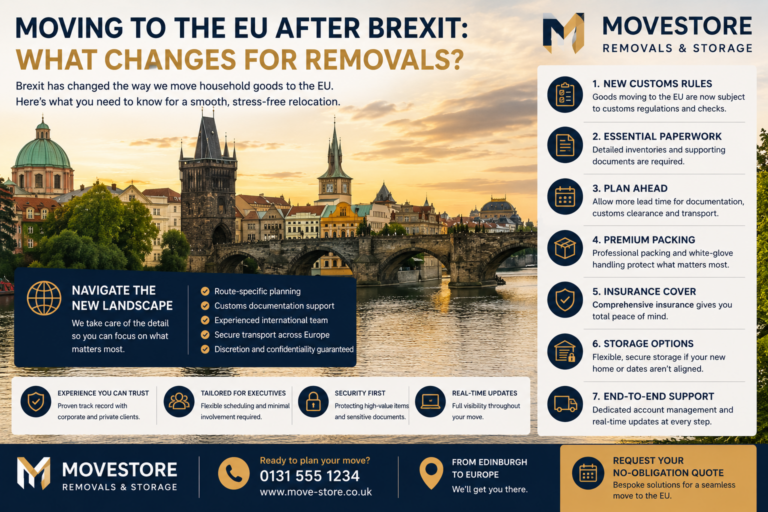
Moving to the EU After Brexit: What Changes for Removals?
Moving from Scotland to an EU country now involves more administration than it did before Brexit. Your household belongings are crossing a customs border, so inventories, supporting documents and destination-country requirements need to be considered alongside packing and transport.
For a corporate relocation, early planning matters. Valuable possessions, confidential documents, work commitments and changing property dates can all add complexity.
The practical difference is simple: an international removal now needs a clear customs plan as well as a moving plan.
If you’re researching international removals from Edinburgh, here are the main changes to understand before you set a moving date.
What changed for removals to the EU after Brexit?
Since Great Britain left the EU customs union, moving household goods from Scotland, England or Wales into an EU member state means taking goods from a non-EU country into the EU.
That can involve customs formalities on both sides of the journey. The European Commission confirms that movements of goods between Great Britain and the EU are subject to customs procedures.
For someone relocating their home, the main practical changes are:
- Your belongings may need to be declared to customs.
- You will usually need a detailed inventory.
- The destination country may ask for evidence that you are genuinely transferring residence.
- Certain goods can be restricted or treated differently.
- Customs paperwork needs to be built into the moving timeline.
- The exact procedure varies depending on the EU country you are moving to.
This is why a post-Brexit European relocation should be planned as an international removal rather than approached like a domestic long-distance move.
Will I have to pay customs duty on my household belongings?
Not necessarily.
EU rules provide customs duty relief for qualifying personal property when someone transfers their normal place of residence from a non-EU country into an EU member state. The relief is subject to conditions.
As a general EU framework, qualifying personal property will normally need to have been:
- In your possession before the move.
- Used by you at your previous residence for the required period.
- Intended for the same personal use at your new residence.
EU rules generally require the person transferring residence to have lived outside the EU for at least 12 consecutive months, while non-consumable goods will normally have needed to be owned and used for at least six months before leaving the previous residence. Exceptions can apply in some circumstances.
However, the procedure and evidence required are handled by the destination country.
Do not assume that qualifying for relief means no paperwork is necessary. Relief usually needs to be claimed through the appropriate customs process.
Customs rules vary between EU countries
There is no single household-removal form that works identically for every EU destination.
The broad EU framework establishes relief for qualifying transfers of residence, but national customs authorities administer the process.
Moving to France may therefore involve different forms or supporting evidence from moving to Spain, Germany, the Netherlands or another EU country.
Before your move, establish:
- Which customs authority is responsible.
- Which declaration process applies.
- What proof of residence is required.
- What evidence of your previous UK residence is needed.
- Whether translations are required.
- Whether documents need to be supplied before the vehicle departs.
- Whether any individual belongings require additional documentation.
Your removal plan should be based on the requirements for your actual destination rather than a generic European checklist.
What paperwork might you need when moving to the EU?
The exact documents vary, but international household removals commonly require more information than a domestic move.
You should be prepared to organise documents such as:
- Passport or identity information.
- Evidence of your UK address.
- Evidence of your new residence in the EU.
- Employment or relocation documentation where relevant.
- Tenancy, property purchase or residence documents.
- A detailed inventory of the belongings being moved.
- Information about the value or ownership of certain items if requested.
- Vehicle documentation if a vehicle forms part of the relocation.
- Customs forms required by your destination country.
The inventory is particularly important.
It needs to give the parties handling the customs process a useful description of what is being transported rather than simply stating “household goods”.
Your removal provider should explain what information it needs from you for the transport process. For destination-country legal or customs requirements, check the relevant authority’s current guidance before moving.
Why a detailed inventory matters
Before Brexit, a household move from Great Britain into many European destinations involved fewer border formalities.
Now, customs authorities may need to understand what is entering the country.
A clear inventory also helps your removal company plan:
- Packing materials.
- Vehicle capacity.
- Loading.
- High-value item handling.
- Customs documentation.
- Unloading.
- Storage requirements.
Start the inventory early rather than attempting to remember everything a few days before departure.
For a larger executive relocation, work through the property room by room.
You can separate belongings into categories such as:
- Furniture.
- Clothing.
- Books.
- Kitchenware.
- Electronics.
- Artwork.
- Personal collections.
- Office equipment.
- Other household effects.
Flag anything unusual or particularly valuable separately.
Allow more planning time for an EU move
International removals should not be planned around the same lead time as a straightforward move across Edinburgh.
Customs preparation introduces dependencies that cannot always be resolved on moving day.
Your timeline may need to allow for:
- Completing inventories.
- Gathering supporting documents.
- Checking destination-country rules.
- Customs processing.
- Packing.
- Access arrangements.
- Transport scheduling.
- Ferry or cross-border route planning.
- Storage if dates change.
The right lead time depends on the destination and complexity of the move.
Rather than working backwards from an assumed number of weeks, speak to your removal company as soon as your likely destination and timeframe are known.
That allows administrative work to begin while your property arrangements are still progressing.
A practical post-Brexit moving timeline
As soon as the relocation is confirmed
Start by confirming the destination, likely moving period and approximate volume of belongings.
At this stage:
- Arrange a moving survey.
- Research the destination country’s residence and customs requirements.
- Identify particularly valuable or unusual belongings.
- Check passport and residency documentation.
- Begin your inventory.
- Discuss whether storage may be required.
Several weeks before moving
Your plans should now become more detailed.
Focus on:
- Completing the inventory.
- Gathering customs documents.
- Confirming packing arrangements.
- Reviewing insurance.
- Checking access at both properties.
- Confirming what will travel with you personally.
- Identifying anything subject to restrictions.
Do not leave customs paperwork until packing is complete.
During moving week
Keep important documents easily accessible.
Confirm:
- Collection arrangements.
- Contact details.
- The inventory being used.
- Items travelling separately with you.
- Destination access.
- Delivery or storage instructions.
Your passport, residency documentation, medication and important personal or business records should not disappear into the main removal load.
What belongings need additional customs attention?
Some categories of goods can fall outside standard transfer-of-residence treatment or be subject to additional restrictions.
EU rules, for example, do not give the same transfer-of-residence relief to alcoholic products and tobacco products as ordinary qualifying household effects.
Other items can also require extra investigation depending on the destination, including:
- Vehicles.
- Alcohol.
- Tobacco.
- Certain foods.
- Plants.
- Weapons or restricted items.
- Some animal products.
- Commercial goods.
- Items intended for sale.
If you own something unusual, do not assume it can simply be included with ordinary household furniture.
Raise it during the planning stage and check the applicable rules before packing.
Protecting valuable belongings on a European move
Customs paperwork is only one part of the process.
Belongings also need to withstand a longer journey involving loading, road transport and potentially additional transport stages.
Identify high-value or delicate items during your moving survey.
Examples may include:
- Artwork.
- Antiques.
- Musical instruments.
- Collections.
- Delicate furniture.
- High-value electronics.
- Personal memorabilia.
Appropriate protection depends on the item.
The plan may involve suitable cartons, furniture protection, cushioning, careful positioning or a more specialist packing approach.
For more complex items, agree the proposed packing method before moving day rather than relying on last-minute decisions.
What about confidential documents?
Corporate executives can have a different set of concerns from a standard household move.
Your home may contain:
- Employment records.
- Financial documents.
- Legal paperwork.
- Company information.
- Personal identity documents.
- Digital storage devices.
Decide which documents genuinely need to be moved and which should remain with you.
Passports, essential immigration documents and anything needed during the journey should stay accessible.
If confidential records are no longer required, arrange appropriate secure disposal before the move rather than transporting unnecessary paperwork across an international border.
For digital devices or employer-owned documents, follow the relevant organisation’s data protection and information-security policies.
Check your insurance arrangements carefully
Do not assume that every valuable possession receives the same level of cover automatically.
Before booking an international removal, ask:
- What cover applies during packing?
- What applies during transport?
- Are there individual item limits?
- Do valuables need to be declared separately?
- Are there exclusions you should understand?
- Does temporary storage change the position?
- Are there packing conditions attached to the cover?
If you have artwork, antiques or other particularly valuable belongings, raise them before accepting the quotation.
You should understand the relevant cover before the goods leave your property.
Storage can help if international dates do not align
One of the most useful ways to reduce pressure on an EU relocation is to avoid forcing collection and delivery onto dates that do not naturally fit.
You might need storage because:
- Your Edinburgh property must be vacated before the new home is available.
- Residency paperwork is still being completed.
- Your employer needs you in the destination country before your household belongings arrive.
- Renovations are taking place.
- Delivery access has changed.
- Your travel schedule moves at short notice.
MoveStore offers containerised storage that can be incorporated into a relocation where appropriate.
Planning this possibility early gives you more flexibility than trying to find an emergency solution once everything is packed.
How is this different from moving within the UK?
The physical principles of careful packing, loading and transport remain similar.
The main difference is the border.
If you were moving from Edinburgh to London, your belongings would not normally be entering a separate customs territory.
Moving from Edinburgh to an EU member state means customs and destination-country rules become part of the removal plan.
That distinction affects:
- Documentation.
- Inventory detail.
- Lead times.
- Restricted items.
- Route planning.
- Delivery scheduling.
This is also why international removals need more preparation even when the geographical distance does not seem particularly large.
What if you’re moving to Ireland?
The Republic of Ireland is an EU member state, so moving there from Great Britain also requires route-specific international planning.
Ferry logistics, documentation, packing and delivery timing all need to work together.
For more detail on that particular route, see Edinburgh to Ireland Removals: How It Works.
Questions to ask an international removal company
When comparing providers, ask practical questions rather than relying on general promises.
Consider asking:
- What information do you need from me for customs purposes?
- Who is responsible for each stage of the customs process?
- What inventory format do you require?
- How should high-value items be declared?
- What packing options are available?
- What insurance arrangements apply?
- How are schedule changes handled?
- Is storage available if the destination property is delayed?
- How will you keep me updated?
- What is included in the written quotation?
For an executive relocation, it can also be useful to establish a clear main point of contact.
That reduces the need to coordinate separately with different people throughout the move.
Post-Brexit EU removals checklist
Before moving day, make sure you have:
- Confirmed the destination-country customs process.
- Checked whether you can claim transfer-of-residence relief.
- Completed an accurate household inventory.
- Gathered supporting residence and identity documents.
- Flagged restricted or unusual items.
- Identified high-value belongings.
- Agreed packing responsibilities.
- Reviewed insurance arrangements.
- Confirmed collection and delivery access.
- Built customs processing into your timetable.
- Discussed storage if dates may change.
- Kept essential documents separate from the removal load.
Requirements can change, so check current government and destination-country guidance as part of your final preparation.
Plan the customs process as carefully as the physical move
Brexit has not made moving from Edinburgh to Europe impractical. It has made preparation more important.
The strongest international moving plan brings the different parts together: customs documentation, inventory preparation, packing, transport, insurance, access and delivery.
For a busy professional, getting these decisions made early reduces the likelihood of paperwork becoming a last-minute problem.
MoveStore can help plan the removal itself around your belongings, dates and destination, with packing and storage options available where appropriate.
Request a no-obligation quotation to discuss your move from Edinburgh to the EU and the practical requirements involved.
FAQs
What customs changes apply when moving to the EU after Brexit?
Great Britain is now outside the EU customs union, so household belongings moving from Scotland, England or Wales into an EU country cross a customs border. Customs declarations and supporting documentation may therefore be required.
Do I have to pay duty on belongings when moving from the UK to the EU?
Qualifying personal property may be eligible for transfer-of-residence relief when you move your normal residence from outside the EU to an EU member state. Conditions apply, and the destination country’s customs authority administers the process.
What paperwork will I need?
Requirements vary by destination. You may need identity documents, evidence of your former and new residence, an inventory and destination-specific customs paperwork. Check the current requirements for the country you are moving to.
How far in advance should I arrange an EU removal?
Start as early as practical once your destination and likely dates are known. International moves require time for inventories, documentation, packing, customs preparation and transport planning, so they should not be treated like a standard local removal.
How should I protect valuable belongings?
Identify high-value or fragile possessions during the survey. Discuss the packing method, handling requirements and relevant insurance arrangements before moving day.
Can I use storage when relocating to the EU?
Yes. Storage can be useful when your UK departure date and European property availability do not match. It can also provide flexibility if work, property or administrative arrangements change.
What should I keep with me instead of putting into the removal load?
Keep passports, residency papers, medication, keys, essential financial or legal documents and anything you will need during the journey with you. Sensitive corporate material should be handled in line with your organisation’s own security policies.
Are customs rules the same across every EU country?
No. EU legislation provides a broad framework, including transfer-of-residence relief, but individual member states administer their own customs procedures and documentation requirements. Always check the rules for your specific destination before moving.