
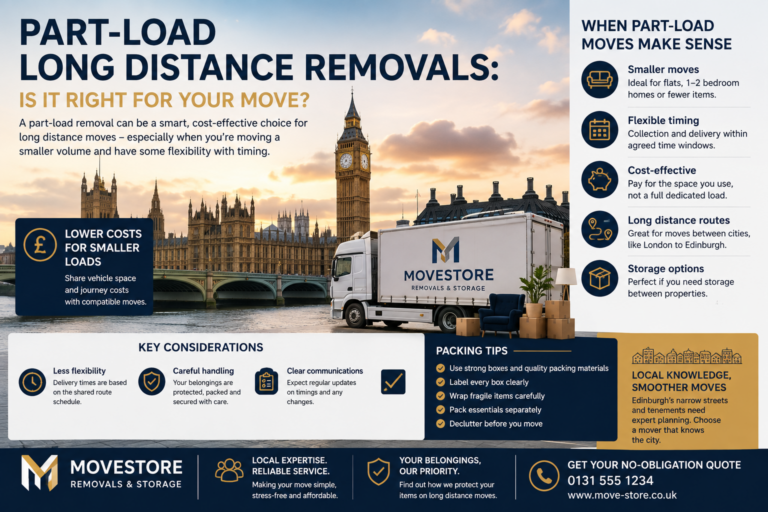
Part-Load Long Distance Removals: When It’s Worth It
If you’re moving a smaller amount of furniture over a long distance, paying for a vehicle dedicated entirely to your belongings may not always be necessary.
A part-load removal combines your belongings with other compatible moves travelling along a similar route. It can make long-distance removals more cost-effective, particularly when you’re moving from a flat, have fewer possessions or can be flexible about collection and delivery dates.
The trade-off is usually timing. A shared load needs to fit around a wider transport schedule, so it won’t suit every move.
Here’s how to decide whether a part-load removal is right for you.
What is a part-load long-distance removal?
A part-load removal is a long-distance move where your belongings share vehicle space with one or more other customers’ loads.
Rather than sending a removal vehicle on a long journey carrying only a relatively small volume, a removal company can plan compatible collections and deliveries along the same route.
This can make better use of available vehicle capacity and may reduce the cost of moving a smaller load.
The important distinction is that a part-load service is not simply about putting unrelated belongings together without a plan. Each customer’s items still need to be identified, protected, loaded carefully and delivered to the correct destination.
If you’re comparing movers long distance, ask how their shared-load service works, how your belongings are kept organised and how collection and delivery windows are agreed.
When is a part-load removal worth considering?
Part-load removals tend to make the most sense when the amount you’re moving is relatively small and your dates have some flexibility.
They can be particularly useful for:
- Moving from a one-bedroom or smaller flat.
- Relocating only part of a household.
- Moving from London to Edinburgh with a modest amount of furniture.
- First-time buyers moving out of furnished rental accommodation.
- Students or young professionals relocating between cities.
- Delivering selected furniture to another part of the UK.
- Moves where storage or temporary accommodation creates flexibility around dates.
If you have a full family home to move, strict completion-day timings or a large volume of belongings, a dedicated removal may be more practical.
Why can part-load removals cost less?
Long-distance removal costs are influenced by more than the number of boxes you own.
Vehicle capacity, mileage, staff time, fuel, access and the time needed for loading and unloading can all affect a quotation.
With a dedicated move, those transport resources are allocated primarily to your relocation. If your belongings occupy only a small proportion of the vehicle, that may not be the most efficient arrangement.
Part-load planning allows compatible moves to share some of the transport journey.
For example, if one customer is moving from London to Edinburgh with a modest load and another collection is travelling along a similar route, combining the journeys may make better use of the vehicle.
That efficiency can make part-load services a lower-cost option for some long-distance removals.
It doesn’t mean every part-load move will automatically be cheaper. The actual quotation still depends on the volume being moved, access conditions, route, handling requirements and scheduling.
The main trade-off: timing and flexibility
Cost is only one part of the decision.
A dedicated long-distance removal can usually be planned more closely around your individual schedule. A part-load service has to coordinate several compatible moves, so collection and delivery may work within wider time windows.
That distinction matters when you’re buying your first home.
If your keys become available at a specific time and everything needs to arrive immediately afterwards, a dedicated service may provide the control you need.
If you can accept delivery within an agreed window, part-load removals become more practical.
Part-load may suit you if:
- Your dates are flexible.
- You can work with an agreed collection or delivery window.
- You have temporary accommodation available.
- Your belongings can arrive shortly after you do.
- You’re using storage between properties.
- Keeping the cost proportionate to a smaller load is important.
A dedicated move may suit you better if:
- You need collection and delivery on specific dates.
- You’re moving a full household.
- You need your belongings immediately on arrival.
- Your completion schedule leaves little room for changes.
- The move includes a significant number of specialist or complex items.
Neither approach is automatically better. The right choice depends on what matters more for your move: scheduling control, cost efficiency or a balance between the two.
Part-load versus full-load long-distance removals
The simplest way to compare the options is to think about vehicle space and scheduling.
Part-load removal
Your belongings share vehicle capacity with other planned moves.
Potential advantages:
- Can be more economical for smaller loads.
- Makes use of spare vehicle capacity.
- Useful for flexible long-distance relocations.
- Can work well when moving from a furnished flat.
Points to consider:
- Collection and delivery may be less flexible.
- Exact timings depend on the planned route.
- You need to understand how belongings are identified and separated.
- It may not suit completion-day moves with tight deadlines.
Dedicated removal
The vehicle and schedule are planned primarily around your move.
Potential advantages:
- Greater control over collection and delivery dates.
- Well suited to larger household moves.
- Straightforward when everything needs to arrive together.
- Often easier to coordinate with fixed property handovers.
Points to consider:
- You may be paying for more vehicle capacity than a small move requires.
- The cost can therefore be higher for relatively modest loads.
A clear written quotation should make it easier to compare the real difference for your circumstances.
Why part-load removals can suit first-time buyers
Many first-time buyers aren’t moving the contents of a large house.
If you’ve spent several years in a small Edinburgh or London rental, you may own a sofa, bed, desk, television, clothes, kitchen equipment and boxes of personal belongings without having enough furniture to fill a removal vehicle.
That is exactly the type of situation where a part-load service is worth asking about.
It allows you to compare the cost of a shared journey against a dedicated removal rather than assuming the same solution is appropriate for every long-distance move.
There is another benefit too: buying your first home often involves changing dates.
Mortgage completion, solicitor arrangements and key collection can make the final timetable uncertain. If you have somewhere to stay temporarily or can use storage, a more flexible part-load schedule may work comfortably around that uncertainty.
If you need everything delivered at a precise time on completion day, however, tell your removal company at the quotation stage.
Moving from London to Edinburgh with a part load
London-to-Edinburgh moves are long enough for vehicle planning to have a meaningful impact on the overall job.
For a smaller load, combining compatible journeys may be sensible where schedules allow.
But the Edinburgh end of the move still needs careful preparation.
Depending on your new address, your removal team may need to consider:
- Narrow tenement stairwells.
- Upper-floor properties without lifts.
- Controlled parking areas.
- Restricted street access.
- Limited space immediately outside the property.
- Long carrying distances from the vehicle.
- Busy central streets.
A quotation should therefore consider more than the motorway journey north.
Give the removal company accurate information about both properties, including floor level, stair or lift access, parking and any particularly large furniture.
Good local knowledge can help avoid unnecessary delays when the vehicle reaches Edinburgh.
How your belongings should be protected on a shared load
One understandable concern is whether sharing vehicle space makes belongings more vulnerable.
The protection principles should remain the same as with any professionally planned removal: appropriate packing, careful handling and organised loading.
Belongings need to be kept identifiable and positioned in a way that reduces unnecessary movement during transit.
If you have fragile, valuable or awkward items, mention these before moving day so the right arrangements can be discussed.
For more detail on loading, padding and protection during longer journeys, read How We Protect Your Belongings on Long-Distance Moves.
Packing tips for a part-load long-distance move
Good packing matters on any relocation, but organisation is particularly useful when your belongings are travelling as part of a shared route.
Use strong, consistent boxes
Damaged or weak cartons are harder to stack securely.
Use suitable moving boxes and avoid making them so heavy that they become difficult to handle safely.
Label every box clearly
Include your name and destination where appropriate, as well as the room the box belongs in.
Clear labelling also makes unloading at your new home much easier.
Protect fragile contents
Use appropriate cushioning around breakable items and reduce empty space inside boxes so contents cannot move excessively.
Separate essentials
Keep medication, identification, chargers, keys, property documents and anything you’ll need immediately with you.
If delivery is taking place within a wider window, pack enough clothing and everyday essentials to cover that period too.
Be accurate about volume
Tell your removal company if the amount you’re moving changes significantly.
Adding furniture or a large number of boxes at the last minute can affect the space reserved for your load and potentially the wider transport plan.
How to compare part-load removal quotes
The lowest figure on a quotation does not necessarily tell you which service offers the best value.
Ask what the price includes and how the process will work.
Useful questions include:
- Is this a part-load or dedicated service?
- What collection window will I receive?
- What delivery window should I expect?
- How are my belongings identified within the load?
- Are loading and unloading included?
- Are there additional charges for stairs or difficult access?
- How will parking requirements be handled?
- What happens if my moving date changes?
- Is storage available if my property is not ready?
- What insurance arrangements apply?
A detailed written quotation makes comparison easier and reduces the risk of discovering unexpected charges later.
Can part-load removals be more efficient?
They can make better use of vehicle capacity when journeys are planned carefully.
If several compatible loads can travel on the same route rather than separate vehicles making similar journeys with unused space, the available capacity is being used more efficiently.
That can reduce unnecessary mileage compared with some partially empty journeys.
The exact effect depends on the route and scheduling, so part-load removals shouldn’t be presented as automatically environmentally preferable in every case. Their practical advantage is that they give removal companies another way to use vehicle space efficiently when compatible moves line up.
What customer service should you expect?
A shared-load service should not mean less communication.
In fact, clear updates become particularly important because the schedule involves more than one collection or delivery.
Before booking, you should understand:
- How dates will be confirmed.
- Who will contact you about changes.
- How precise the collection and delivery windows are.
- What happens if your property transaction is delayed.
- Who you contact if you have a question during the move.
For a first significant move, knowing what happens next can be just as valuable as the physical removal itself.
Part-load removal checklist
A part-load move is worth considering if you can answer yes to most of these questions:
- Are you moving a relatively small volume of belongings?
- Can you be flexible about collection or delivery?
- Would a dedicated vehicle provide much more space than you need?
- Are you comfortable working within an agreed delivery window?
- Do you have somewhere to stay if your belongings arrive after you?
- Have you provided accurate access information for both properties?
- Have you received a clear written quotation?
- Do you understand how your belongings will be protected and identified?
- Have you checked what happens if your dates change?
If you need exact timings or are moving a large household, ask for a dedicated-removal quotation as well so you can compare both approaches properly.
Is a part-load long-distance removal right for you?
Part-load removals work best when a smaller load and flexible schedule come together.
For a young professional moving from a London or Edinburgh flat, they can offer a practical way to keep the cost of a long-distance move proportionate to the amount being transported. They also make good use of vehicle capacity where journeys can be coordinated.
The compromise is timing. If you need complete control over collection and delivery, a dedicated removal is likely to be the more suitable option.
MoveStore can talk through the size of your move, your dates, access at both addresses and any flexibility you have before recommending an appropriate approach.
Get a no-obligation quote and we’ll explain the options clearly so you can decide what works for your move.
FAQs
What are the benefits of part-load long-distance removals for first-time buyers?
Part-load removals can be useful when you have fewer belongings than would normally require a dedicated removal vehicle. By sharing vehicle capacity with compatible moves, the cost can sometimes be kept more proportionate to the size of your load.
How can a part-load removal save money?
A shared load allows available vehicle space and parts of the long-distance journey to be used across more than one compatible move. This can be more efficient than dedicating an entire vehicle to a small load, although the final cost still depends on access, volume, distance and timing.
What are the trade-offs of part-load removals?
The main trade-off is flexibility. Collection and delivery usually need to fit around a planned route involving other customers, so a part-load service may offer less control over exact timings than a dedicated move.
How do I know whether a quote has transparent pricing?
Ask for a written quotation showing what is included and what could lead to additional charges. Check access requirements, collection and delivery arrangements, packing, storage and any other services you may need.
Is a part-load move suitable for moving from London to Edinburgh?
It can be, particularly if you’re moving a smaller amount of furniture and can work with flexible dates. The suitability will depend on the volume, access at each property and how closely your delivery needs to align with your arrival.
Are part-load removals safe for fragile belongings?
Sharing vehicle space does not remove the need for careful protection. Fragile belongings should still be packed appropriately, identified clearly and positioned securely. Tell your removal company about delicate or valuable items in advance.
What should I pack separately for a part-load move?
Keep documents, medication, chargers, keys, valuables and enough everyday essentials for the period between collection and delivery with you. This is particularly useful when the service operates within a delivery window rather than a fixed arrival time.