
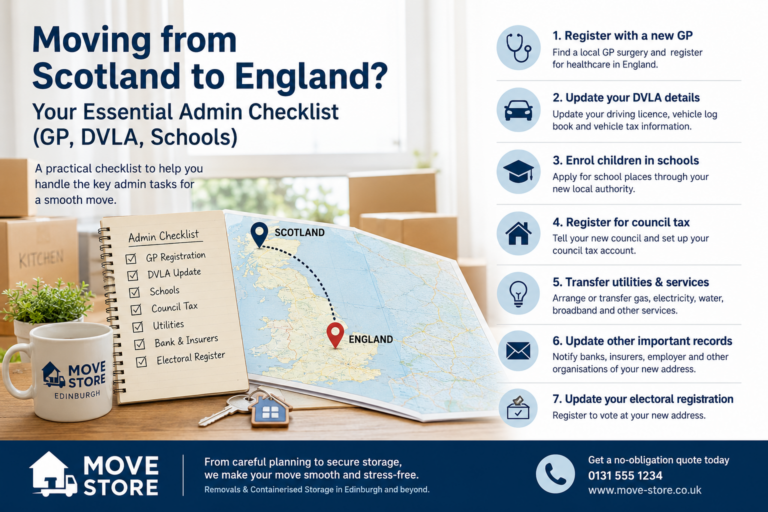
Moving Scotland to England: Admin Checklist (GP, DVLA, Schools)
Moving from Scotland to England involves more than packing boxes and arranging your removal. You’ll also need to update important records, register for local services and, if you have children, organise their new school places.
The good news is that most of these jobs are straightforward once you know what needs doing. Some can be completed before moving day, while others are best handled as soon as you have your new English address.
This checklist covers the main admin tasks for moving to England, including GP registration, DVLA changes, schools, council tax, utilities and other records that are easy to overlook.
If you’re still working out the practical side of the journey, our guide to long distance removal costs UK explains some of the factors that can affect the cost of a longer-distance move.
What is the admin checklist for moving from Scotland to England?
For most households, the essential tasks are:
- Register with a GP surgery in England.
- Update your driving licence address with the DVLA.
- Update your vehicle log book and other DVLA records if applicable.
- Apply for school places if you have children.
- Register for council tax at your new address.
- Arrange or transfer gas, electricity, water and broadband.
- Update banks, insurers, employers and other organisations.
- Redirect your post and change important delivery addresses.
- Update your electoral registration.
- Keep key moving and identity documents together until the transition is complete.
You don’t need to complete everything on the same day. Splitting the list into tasks for before the move, moving week and after arrival makes it much easier to manage.
1. Register with a new GP after moving to England
Healthcare is one of the first things worth organising once you know where you’ll be living.
In England, you can register with a GP surgery free of charge. Most people choose a surgery close to their new home, although some practices accept patients from outside their immediate area. Many surgeries now allow you to register online.
How to register with a new GP
Start by finding GP practices near your new postcode. Check whether they’re accepting new patients and whether online registration is available.
You’ll normally be asked for information such as:
- Your full name and date of birth.
- Your new address.
- Your previous GP surgery details, if you have them.
- Emergency contact details.
- Information needed to help identify and transfer your medical records.
The NHS advises that you do not need to tell your existing GP surgery that you’re changing practices. Once your new registration is completed, the appropriate processes can begin to transfer your records.
If you take regular medication, it’s sensible to make GP registration a priority. Keep an adequate supply for the moving period where possible and have the names and dosages of your medicines available.
Healthcare is organised differently in England
Moving from Scotland to England means entering a different part of the UK healthcare system. Your NHS care continues, but administration and some services are organised differently.
Rather than assuming that arrangements you had in Scotland will transfer automatically, check your new GP, dentist and any ongoing specialist care individually.
If someone in your household has continuing treatment or additional healthcare needs, contact the relevant service before moving where possible. Having copies of appointment letters, medication information and key contact details can make the transition easier.
2. Complete your DVLA update after moving
If you drive, changing your address is more than a simple change to your driving licence.
The DVLA says motorists moving home may need to update several separate records, including their driving licence, vehicle log book and vehicle tax Direct Debit.
Update your driving licence address
You must update the address on your full or provisional driving licence when you move permanently.
Changing the address itself is free, and you can continue driving while waiting for your updated licence. The online process requires you to be resident in Great Britain and have the relevant licence details available.
If you’re changing your name at the same time, a different process may apply, so check the current DVLA instructions before sending anything.
Update your V5C vehicle log book
If you’re the registered keeper of a vehicle, changing your driving licence does not automatically update the address on its V5C log book.
You need to change that separately. GOV.UK states that failing to notify the DVLA of an address change can lead to a fine of up to £1,000.
You should also check whether you need to update:
- Your vehicle tax Direct Debit.
- V750 or V778 documents for a personalised registration.
- Trailer registration details, where relevant.
Treat these as separate checklist items rather than assuming one DVLA form changes everything.
Don’t forget your motor insurance
Your insurer also needs your new address.
Where you live can affect how your policy is assessed, so provide the correct address from the appropriate date. Check your policy rather than waiting until renewal.
3. Arrange school places when moving from Scotland to England
If you’re moving with children, school applications deserve early attention because the Scottish and English education systems operate separately.
For state-funded primary and secondary schools in England, applications normally follow the admissions process for the relevant local authority. If you’ve just moved to England or are moving to another area, GOV.UK advises following the application process for the council covering the area concerned. You may be asked to provide evidence of your new address.
Start with your new local council
Once you know your destination address:
- Identify the local authority responsible for the property.
- Check its school admissions guidance.
- Research schools in the area.
- Confirm whether you’re making a normal admissions-round or in-year application.
- Gather the requested evidence.
- Submit the application as early as the relevant process allows.
For applications during an existing school year, contact the local council about the area’s in-year admissions arrangements.
Documents you may need for school enrolment
Requirements vary, but it’s useful to keep together:
- Proof of your new address.
- Your child’s birth or identity documents.
- Details of their current school.
- Relevant education records.
- Details of additional support or special educational needs, where applicable.
- Medical information the new school needs to know.
GOV.UK notes that families moving into an area may need evidence such as a mortgage agreement, tenancy agreement or property deeds to demonstrate their new address or intended residence.
Avoid withdrawing your child from their existing school until you understand the arrangements for their new place and your confirmed moving dates.
4. Register for council tax at your new address
Your Scottish council tax account and your new English council tax account are handled by different local authorities.
Tell your current Scottish council when you’re leaving and give the information it requests for your final bill. You’ll then need to register with the council covering your new home in England.
Have the following information ready:
- Your moving date.
- Your old and new addresses.
- Names of the adults moving into the property.
- Whether you own or rent the new home.
- Your tenancy start date or completion date, where relevant.
If there’s a gap between properties, check with the relevant councils about your liability rather than assuming one account ends exactly when the other begins.
5. Transfer your utilities and household services
Utilities are easier to deal with when you plan them before moving day.
Contact your current providers and tell them when you’re leaving. On the day you move, take clear meter readings where applicable and keep photographs for your records.
For your new property, check:
- Electricity.
- Gas, if supplied.
- Water.
- Broadband and landline services.
- Mobile accounts where the billing address needs updating.
- TV Licensing requirements.
Broadband is particularly worth arranging in advance if you work from home. Installation availability can vary, and your existing provider may not necessarily offer the same service at your new address.
Keep confirmation emails and final bills until all old accounts have been settled.
6. Update your bank, employer and other important records
Address changes tend to involve more organisations than people first expect.
Rather than trying to remember them all on moving day, make a list several weeks beforehand.
Consider notifying:
- Banks and building societies.
- Credit card providers.
- Mortgage or finance providers.
- Your employer.
- Pension providers.
- Home, motor, life and other insurers.
- HMRC where your circumstances require an update.
- Mobile and subscription providers.
- Professional membership organisations.
- Delivery and shopping accounts you regularly use.
- Universities or education providers.
- Vet practices and pet insurance providers.
If you regularly receive important letters, consider arranging Royal Mail redirection as an additional safeguard. It shouldn’t replace changing your address directly with organisations, but it can help catch correspondence you’ve forgotten about.
7. Update your electoral registration
Your electoral registration does not simply follow you from one council area to another.
Once you have moved, check the process for registering to vote at your new address. If an election is approaching, do this promptly so you can check the relevant deadlines and voting arrangements.
It’s also worth reviewing any postal or proxy voting arrangements you previously had.
8. Keep important documents with you during the move
One of the simplest moving house tips is to avoid putting every important document into a removal box.
Keep a folder or secure bag with documents you may need immediately.
This might include:
- Passports and driving licences.
- House purchase or tenancy paperwork.
- Moving-company paperwork.
- Insurance details.
- Vehicle documents.
- School records.
- Prescription and medication information.
- Important contact numbers.
- Laptop and phone chargers.
- Keys for both properties where applicable.
Carry this folder with you rather than packing it into the removal vehicle. That way, you can access information even if other belongings are still in transit or being unloaded.
When should you complete each moving admin task?
Two to four weeks before moving
Where possible:
- Research GP surgeries near the new home.
- Begin investigating school admissions.
- Arrange broadband.
- Tell utility providers about the planned move.
- Start your address-change list.
- Consider post redirection.
- Gather important documents into one place.
If completion dates are still uncertain, avoid cancelling services too early. Flexibility matters, particularly for first-time buyers whose dates may depend on solicitors, mortgage completion and other parts of the property chain.
During moving week
Focus on tasks tied to the actual handover:
- Take final meter readings.
- Confirm utilities at the new property.
- Keep key paperwork with you.
- Check insurance arrangements.
- Notify relevant providers once your address change becomes effective.
A written checklist is useful here. Moving day itself is busy enough without relying on memory.
During the first week after moving
Once you’re settled enough to tackle the remaining paperwork:
- Register with your new GP.
- Complete DVLA address changes.
- Confirm council tax registration.
- Finish school admission arrangements.
- Update banks and other accounts.
- Check that important correspondence is reaching your new address.
What are the main differences when moving from Scotland to England?
This is still a domestic UK move, so you’re not dealing with customs declarations or international shipping procedures. However, some public services are devolved, which means the systems and processes you use can change when you cross the Scottish-English border.
Healthcare and education are two of the clearest examples.
That makes this type of relocation different from a move between two Scottish cities. The physical removal may be straightforward, but you’ll want a clear admin plan for services that need to be re-registered or transferred.
If you’re making the journey in the opposite direction or want more context about living in the capital, see Moving to Edinburgh: A Guide to Life in Scotland’s Capital.
How to make the physical move easier alongside the admin
Paperwork is only one part of a long-distance move. Access, parking, packing and timings all need to fit together as well.
For an Edinburgh departure, think about:
- Whether a removal vehicle can park close to the property.
- Narrow staircases or tenement closes.
- Lift access in either property.
- Items requiring extra protection or dismantling.
- Your key collection or completion time.
- The distance and expected journey between addresses.
- Whether everything needs to arrive on the same day.
If your English property isn’t ready when you leave Scotland, storage can also help separate the two dates. Rather than forcing the whole move into one day, belongings can be kept securely until you’re ready for delivery.
When comparing providers, ask for a clear written quotation and make sure you understand what is included. Our guide on How to Choose a Removals Company in Edinburgh covers the practical questions worth asking before you book.
Your Scotland-to-England admin checklist at a glance
Before you close the door on your Scottish property, check that you have a plan for:
- Healthcare: research and register with an English GP.
- Driving: update your licence and any relevant vehicle records.
- Schools: contact your new local authority and understand the admissions process.
- Council tax: close or update your Scottish account and register in England.
- Utilities: record readings and arrange services at both addresses.
- Finances: update banks, insurers and finance providers.
- Employment: give your employer your new details.
- Post: change addresses directly and consider redirection.
- Voting: update your electoral registration.
- Documents: keep essential paperwork accessible throughout the move.
Taking these jobs one at a time is far easier than trying to complete everything after the boxes arrive.
A calmer way to manage your move from Scotland to England
Moving from Scotland to England can involve a long list of practical details, particularly when you’re buying your first home. The most useful approach is to separate the physical removal from the administrative tasks and give each one a clear timeline.
At MoveStore, we help plan long-distance removals around your dates, access requirements and the belongings you need to move. If dates don’t line up neatly, storage can also provide extra flexibility rather than forcing everything into a single handover day.
For help planning the removal itself, get a no-obligation quote from MoveStore. We’ll talk through the details of your move and explain the available options clearly.
FAQs
What is the admin checklist for moving from Scotland to England?
Your main tasks include registering with an English GP, updating DVLA records, arranging school places where needed, registering for council tax, transferring utilities and updating banks, insurers and other organisations with your new address.
Breaking the list into pre-move and post-move tasks can make it much easier to manage.
How do I register with a new GP after moving to England?
Find a GP surgery serving your new area and complete its registration process. Most surgeries offer online registration, although other options are available. You do not normally need to contact your previous GP surgery separately when changing practices.
What DVLA information do I need to update after moving?
You need to update the address on your driving licence. If you’re a vehicle’s registered keeper, you also need to change the V5C log book separately, along with relevant vehicle tax Direct Debit or personalised registration records.
How do I enrol my children in schools after moving to England?
Start with the local authority responsible for your new area and follow its admissions process. If you’re moving during the school year, ask specifically about in-year admissions. You may need evidence showing your new address.
What documents should I keep handy when moving from Scotland to England?
Keep identification, property paperwork, vehicle documents, school information, medication details, insurance records and essential moving paperwork with you. Avoid packing anything you may need immediately into the removal vehicle.
Do I need an international removal service to move from Scotland to England?
No. Scotland and England are both within the UK, so this is a domestic long-distance removal rather than an international move. The main differences to plan for are the distance involved and the separate administrative arrangements for services such as healthcare and education.