
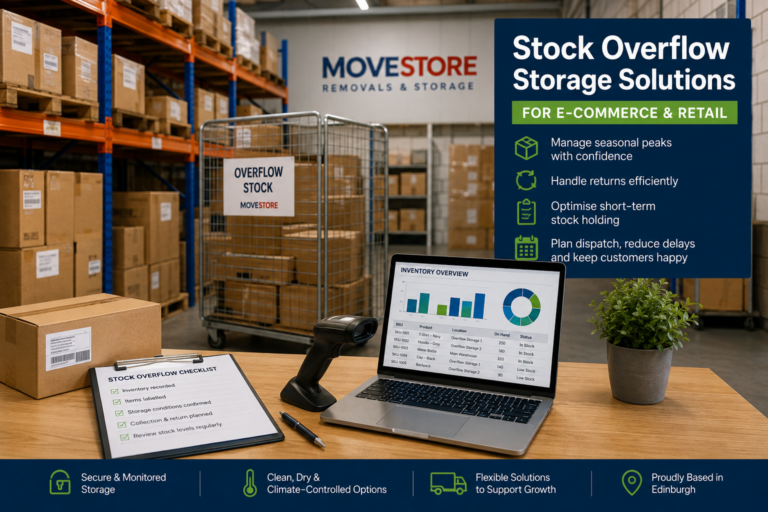
Stock Overflow Storage for E-commerce and Retail
Growth is positive, but extra stock can quickly put pressure on the space you use every day. Seasonal demand, bulk purchasing, returns and new product launches can all leave e-commerce and retail businesses with more inventory than their premises can comfortably hold.
Stock overflow storage gives you somewhere secure to keep that additional inventory without committing to larger permanent premises before you need them. For Edinburgh businesses, it can also make busy periods easier to manage by separating reserve stock from the products and equipment needed for daily operations.
MoveStore provides commercial storage solutions for businesses that need additional space during periods of change, growth or fluctuating demand. The right arrangement depends on what you are storing, how often you need it and how quickly stock needs to move back into your operation.
What is stock overflow storage?
Stock overflow storage is additional storage space used when your normal premises cannot comfortably accommodate all of your inventory.
For an e-commerce or retail business, that could include:
- Seasonal products bought ahead of a peak sales period.
- Bulk orders secured from suppliers.
- Returned goods waiting to be assessed or processed.
- Packaging materials and display equipment.
- Slower-moving stock that does not need to occupy valuable operational space.
- Equipment or documents displaced during an office, shop or warehouse change.
Unlike permanently increasing your premises, flexible storage allows you to add capacity when it is needed and reduce it again when stock levels fall.
That can be particularly useful for businesses whose inventory changes significantly throughout the year.
How can overflow storage help during seasonal peaks?
Seasonal demand can create a difficult balance. Order too little and you risk running short. Order too much and boxes, cartons and pallets can begin taking over working areas.
Seasonal peaks storage creates a buffer between your normal working stock and additional inventory held for future demand.
For example, an Edinburgh retailer preparing for Christmas might receive stock several weeks before it is needed on the shop floor. An online business running a major promotion may need extra inventory for a shorter period.
Keeping reserve stock elsewhere can help you:
- Keep aisles, packing areas and workspaces clear.
- Receive stock earlier without overcrowding your premises.
- Release inventory in manageable batches.
- Separate current stock from future or promotional stock.
- Avoid making a long-term property decision simply to solve a temporary capacity problem.
The important part is planning how stock will move in and out of storage before the busy period begins.
Use storage as part of your ecommerce inventory management
Overflow storage works best when it forms part of your wider ecommerce inventory management process rather than becoming a place where surplus stock is simply left.
A clear inventory system should show what is in storage, where it is located and when it may be required.
Keep a reliable inventory record
Before stock goes into storage, record key details such as:
- Product or SKU.
- Quantity.
- Batch or delivery date where relevant.
- Storage container or location.
- Priority for retrieval.
- Any special handling requirements.
Your inventory record does not need to be complicated, but it should be accurate enough for anyone responsible for stock to understand what is being held.
Group stock by operational need
Avoid organising stock solely according to when it arrived.
Instead, consider how your team will need to retrieve it. You might separate:
- Fast-moving products.
- Seasonal stock.
- Promotional inventory.
- Returns.
- Packaging materials.
- Long-term reserve stock.
Good organisation can reduce unnecessary handling when particular products need to come back into circulation.
Make short-term stock holding work with dispatch planning
Short-term stock holding can support a busy operation, but only if the movement of goods is planned carefully.
Start by deciding which stock genuinely needs to remain at your main premises. Products needed for immediate picking and packing should normally stay close to the dispatch area, while reserve quantities can be stored separately.
You can then plan regular replenishment based on sales and stock levels.
A simple approach is to:
- Identify the minimum quantity needed at your operational site.
- Keep reserve quantities clearly recorded in overflow storage.
- Monitor sales or order volumes.
- Arrange stock movements before working inventory reaches a critical level.
- Review the process after peak periods to improve future planning.
The aim is not simply to maximise the amount of stock held elsewhere. It is to make sure the right stock is in the right place when your team needs it.
How can overflow storage help with handling returns?
Returns can create their own storage problem, particularly after Christmas, promotions or other periods of high sales.
Returned products often need to be kept separate from saleable inventory while they are inspected, repackaged, repaired or processed.
An overflow area can help create that separation.
You might divide returned stock into categories such as:
- Awaiting inspection.
- Ready to return to sale.
- Awaiting supplier return.
- Damaged or incomplete.
- Pending administrative action.
This makes handling returns more structured and reduces the risk of returned goods becoming mixed with stock that is ready for dispatch.
For businesses dealing with large volumes, it is also useful to decide how frequently returns will be reviewed. Regular processing prevents a temporary overflow area from becoming permanent unmanaged stock.
Flexible storage can help you avoid unnecessary permanent space
One of the main advantages of flexible storage solutions is that they can help businesses respond to changing stock levels without immediately increasing their fixed premises.
That matters when demand is uncertain.
You may need substantially more room for three months of the year but relatively little additional capacity during the remaining nine. In that situation, taking on more permanent retail or warehouse space could leave you paying for capacity you rarely use.
Overflow storage can instead support:
- Seasonal demand.
- Temporary supplier deliveries.
- Shop refurbishments.
- Office relocations.
- Business expansion.
- Product launches.
- Changes to your normal supply chain management.
If your requirement is broader than stock alone, our guide to Flexible Storage for Businesses in Edinburgh explains other situations where additional business storage can help.
What should you look for in excess inventory storage options?
Not every storage arrangement will suit every business. The right excess inventory storage options for online and retail businesses depend on the products involved and how they fit into your operation.
Before choosing a solution, consider the following.
Security
Ask how the facility is monitored and how your stock is handled once it enters storage.
For business-critical inventory, clear records are important too. You should know what has been stored and have an organised process for managing future movements.
Clean, dry storage conditions
Many ordinary retail products need a clean and dry environment to remain in good condition.
Check whether the storage conditions are suitable for the goods you intend to hold, including any packaging that could be affected by damp or poor storage conditions.
Environmental requirements
Some products are more sensitive to temperature or humidity than others.
If your inventory genuinely requires climate-controlled storage, confirm that the provider can meet the relevant environmental requirements before placing goods into storage. Do not assume that standard business storage provides specialist temperature control.
Storage duration
Consider whether you need space for a few weeks, several months or on an ongoing basis.
A flexible arrangement can be useful if the exact end date depends on sales volumes, a refurbishment programme or the completion of new premises.
How stock will be collected and returned
Think about movement as well as storage.
Who will collect the stock? How will it be protected? Will it need to come back in one delivery or several planned stages?
Answering these questions in advance makes the arrangement easier to manage.
Stock overflow storage during business growth
Edinburgh business growth does not always happen neatly.
You may employ more people before larger premises become available. A shop refurbishment can temporarily reduce your available stockroom. An office relocation can coincide with a busy trading period. You might also need to move equipment, documents and stock at the same time.
In these situations, storage and removals planning can work together.
A professional removals team can help you plan which items move directly to their new location and which should go into temporary storage. This can prevent unnecessary handling and help keep operational areas available for staff.
For businesses moving within Edinburgh, access also needs to be considered early. City-centre streets, parking restrictions, loading arrangements and building access can all affect how a commercial move is organised.
A clear plan gives everyone involved a better understanding of when stock, furniture or equipment will move and where each item is going.
Protect sensitive equipment and business documents
Overflow requirements are not always limited to retail stock.
During an office move or expansion, you may also need somewhere to hold equipment, filing systems, furniture or archived documents.
These items should be treated according to their individual requirements.
Sensitive documents should be clearly identified and managed through an appropriate internal process so that confidentiality is maintained. IT and specialist equipment may require additional protection during handling and transport.
It is useful to create a separate inventory for these assets rather than combining them with ordinary retail stock.
That gives your team a clearer record of what has moved into storage and what needs to be returned to particular departments or locations.
Warehouse storage solutions versus flexible overflow storage
Traditional warehouse storage solutions can make sense for businesses with substantial, predictable inventory requirements and established fulfilment processes.
Flexible overflow storage solves a slightly different problem.
It is often more appropriate when the requirement is temporary, irregular or linked to a specific business event.
For example:
- A retailer needs extra capacity before Christmas.
- An e-commerce business receives a larger supplier shipment than expected.
- A company is between commercial premises.
- A refurbishment temporarily removes access to a stockroom.
- Returned inventory needs to be separated from active stock.
The deciding factor should be how the storage space supports your day-to-day operation rather than simply how much space is available.
Is overflow storage the same as logistics fulfilment?
No. Storage and logistics fulfillment are related, but they serve different purposes.
Overflow storage provides additional capacity for goods that you do not currently have room to keep on site. Fulfilment typically involves operational activities such as picking, packing and sending customer orders.
If you require a full fulfilment operation, check carefully which services a provider offers.
For businesses that mainly need additional space while continuing to manage their own order processing, stock overflow storage can provide useful breathing room without changing the entire fulfilment process.
A practical stock overflow checklist
Before moving excess stock into storage, work through these steps:
- Identify which products genuinely need to be stored off site.
- Record quantities and product references.
- Separate seasonal, reserve and returned stock.
- Confirm any special storage requirements.
- Decide how stock will be labelled.
- Plan how often you expect inventory to be returned.
- Keep dispatch stock separate from longer-term reserves.
- Confirm collection, loading and delivery arrangements.
- Record sensitive equipment or documents separately.
- Review stock levels regularly so unnecessary inventory does not remain in storage.
How MoveStore can support your business storage plans
When you need additional business space, the most useful starting point is a clear understanding of what needs to be stored and how the items will move.
At MoveStore, we can discuss your stock, equipment or business storage requirements and help you plan the practical logistics around collection, storage and return.
For businesses also relocating, storage can be incorporated into the wider removals plan so that items do not all need to arrive at the new premises at once. That can help keep workspaces clearer and support a more controlled transition.
The right approach will depend on your stock volume, access arrangements, storage duration and operational timetable.
Conclusion
Stock overflow storage can give e-commerce and retail businesses additional capacity without forcing a temporary stock problem into a permanent property decision.
Used alongside accurate inventory records and sensible dispatch planning, it can help you manage seasonal peaks, returns, business changes and short-term increases in stock while keeping working areas organised.
If your Edinburgh business needs additional storage or you are planning a commercial move, speak to the MoveStore team for a no-obligation quotation and to discuss the most practical arrangement for your stock.
FAQs
What is stock overflow storage and how does it benefit e-commerce businesses?
Stock overflow storage provides additional space for inventory that cannot comfortably fit within your normal premises. It can help e-commerce businesses manage seasonal demand, larger supplier orders and temporary stock increases without immediately committing to larger permanent premises.
What are the key challenges of managing stock overflow during seasonal peaks?
The main challenges are keeping accurate inventory records, maintaining enough working stock for dispatch and avoiding unnecessary handling. Planning replenishment before the peak period begins can make the process easier to control.
How can flexible storage solutions improve inventory management for retail operations?
Flexible storage lets retailers separate reserve inventory from stock needed for immediate sale. This can keep stockrooms and working areas clearer while allowing additional products to be brought back into the operation when required.
What are the advantages of climate-controlled storage for sensitive products?
Where a product genuinely needs controlled environmental conditions, climate-controlled storage can help maintain an appropriate temperature or humidity range. Businesses should confirm the precise requirements of their goods and verify that a storage provider can meet them before storing sensitive inventory.
How can businesses in Edinburgh effectively handle returns with stock overflow storage?
Returned products can be held separately from saleable stock while they are checked, repackaged or processed. Clear labelling and a regular review schedule help prevent returns from building up or becoming mixed with active inventory.
What role do professional removal services play in managing stock overflow during business expansion?
A removals team can help plan how stock, furniture and equipment move between your existing premises, storage and the new location. Coordinating those movements can reduce unnecessary handling and help businesses manage a relocation with less disruption.
How can e-commerce businesses optimise short-term stock holding and dispatch planning?
Keep immediate dispatch stock close to your packing operation and hold reserve inventory separately. Monitor stock levels regularly and arrange replenishment before working inventory becomes too low.
What factors should businesses consider when choosing a stock overflow storage solution?
Consider security, storage conditions, the length of time you need space, how stock will be recorded and how it will be collected and returned. Any specialist environmental or handling requirements should also be confirmed in advance.
How does secure storage help protect sensitive equipment and documents?
Secure storage reduces unnecessary exposure while equipment or documents are temporarily away from their normal location. Businesses should also maintain clear inventory records and follow their own confidentiality and data-handling procedures.
What are good practices for managing inventory levels in e-commerce?
Maintain accurate stock records, distinguish active inventory from reserves, monitor sales patterns and review slow-moving products regularly. Overflow storage should support those processes rather than replace active inventory management.