
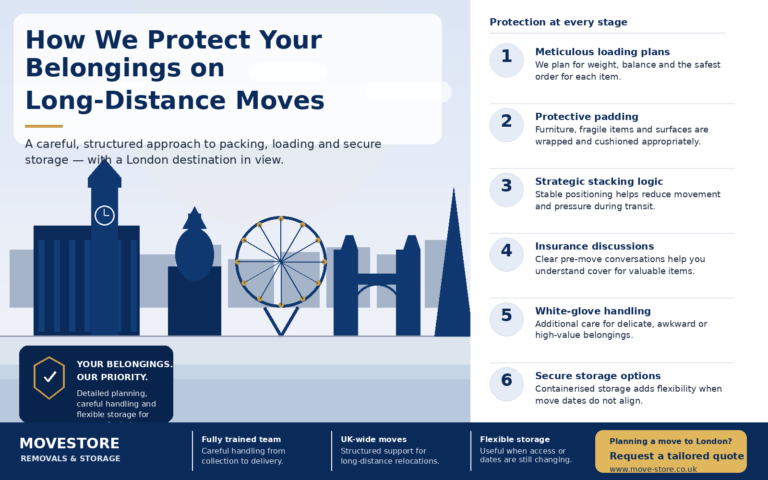
How We Protect Your Belongings on Long-Distance Moves
A long-distance move puts your belongings through more handling and more time in transit than a short local move. Good protection therefore starts long before the removal vehicle leaves your property.
At MoveStore, we approach protection as a complete process. That means planning how items will be packed, deciding the safest loading order, using appropriate protective materials and arranging the load so that belongings remain as stable as possible throughout the journey.
For anyone arranging long distance moving, understanding these steps can make it much easier to assess how your removal will be managed and what you should discuss before moving day.
How do we protect belongings during a long-distance move?
Protecting belongings on a long-distance relocation involves five main steps:
- Plan the move and identify items needing additional care.
- Pack and pad belongings appropriately for their size and fragility.
- Load in a structured order to manage weight and stability.
- Secure the load to reduce unnecessary movement in transit.
- Plan unloading, delivery or storage before the journey begins.
Each part supports the next. Good packing cannot compensate for poor loading, just as a careful loading plan cannot fully protect an inadequately packed fragile item.
The aim is to manage these risks as one coordinated process.
Protection starts with a detailed moving plan
Long-distance protection begins with understanding exactly what needs to move.
Before loading, the team needs to know about larger furniture, delicate objects, awkward items and anything requiring particular care. Access at both properties matters too. Tight stairs, lifts, restricted parking and long carrying distances can all affect how belongings should be prepared and handled.
A clear plan also helps determine:
- Which items may need dismantling.
- Which belongings need additional padding.
- Whether specialist packing should be discussed.
- The order in which items should be loaded.
- What you may need immediately on arrival.
- Whether some belongings are going into storage rather than directly to the new property.
For an executive or corporate relocation, this preparation can also reduce the amount of day-to-day involvement required from you. Once the key decisions have been agreed, the removal can follow a structured plan rather than relying on decisions being made during loading.
Why loading plans matter on long-distance moves
How belongings are positioned inside a removal vehicle has a direct bearing on how stable the load remains.
A professional loading plan considers weight, size, shape and fragility. Heavy, stable items generally need to provide a secure foundation, while belongings that could be crushed or damaged require appropriate positioning and protection.
The objective is not simply to fit everything into the available space. It is to create a balanced, organised load in which items support rather than endanger one another.
Managing weight distribution
Large pieces of furniture, boxes of books and other dense items need careful positioning.
Concentrating too much weight in one part of a load can make the arrangement less stable. A considered loading sequence helps distribute heavier items appropriately and creates a stronger base for lighter belongings.
Keeping fragile items away from pressure
Delicate boxes should not become structural supports for heavier furniture.
Items requiring extra care are identified during planning so they can be positioned appropriately rather than squeezed into whatever space happens to remain at the end of loading.
Planning before the first item is lifted
Loading becomes much more effective when the team already understands what is being moved.
This is one reason accurate information during the quotation or moving survey is useful. It allows the removal team to plan for the volume, larger pieces and any unusual requirements before moving day.
Padding helps protect individual items
Protective materials provide a barrier between your belongings and the normal contact that occurs during handling and transport.
The appropriate method depends on the item. Furniture, glass, artwork and electronics do not all require the same treatment.
Protection may involve a combination of:
- Furniture covers.
- Wrapping materials.
- Packing paper.
- Protective padding.
- Strong moving cartons.
- Internal cushioning for fragile items.
- Corner or surface protection where appropriate.
The important point is that padding should suit the item rather than simply adding as much material as possible.
A fragile object also needs to be secure inside its carton. Empty space can allow movement, while overpacked boxes can put pressure on delicate contents.
Strategic stacking reduces movement in transit
Even carefully wrapped belongings can be damaged if they are allowed to move excessively during transport.
Strategic stacking is therefore an important part of transit risk reduction. The aim is to create a stable load with as few opportunities as possible for boxes and furniture to shift as the vehicle accelerates, brakes or changes direction.
Building a stable base
Heavier and structurally strong items are positioned so that they help create a stable foundation.
Lighter or more delicate belongings can then be positioned without being expected to carry inappropriate weight.
Avoiding unstable gaps
An organised load makes sensible use of available space.
Large gaps can give items room to move. At the same time, belongings should not simply be forced into spaces where they could be crushed or damaged.
The correct balance comes from planning the load as a whole.
Securing items for the journey
Where appropriate, items can also be secured to help maintain their position during transit.
The exact approach depends on the vehicle, the belongings and the journey. The principle remains the same: once something has been carefully packed and positioned, it should remain as stable as reasonably possible until unloading.
How we approach high-value and delicate belongings
High-value item protection begins with identifying those belongings before moving day.
Tell your removal company about valuable, delicate or unusual items during the survey or quotation process. This provides an opportunity to discuss handling, packing and any additional arrangements before the move is underway.
Examples might include:
- Artwork.
- Antiques.
- Delicate furniture.
- Musical instruments.
- Collections.
- High-value electronics.
- Important personal possessions.
Some items may require a different packing or handling approach from standard household belongings.
For particularly important possessions, it is sensible to agree the proposed method in advance rather than raising the requirement when the team arrives.
What does white-glove handling mean in a removal?
The term white-glove handling generally describes a higher level of hands-on care, planning and attention for belongings requiring particular protection.
In practical terms, that means identifying special requirements in advance, using suitable protective methods and coordinating handling carefully from collection through to placement at the destination.
For corporate executives, the value is often as much about organisation as physical handling. A well-managed relocation reduces the number of decisions you need to make during a demanding moving day and creates a clear process for particularly important belongings.
Requirements vary between moves, so any specialist handling should be discussed during the quotation or survey.
Check insurance arrangements before moving day
Insurance should never be treated as an afterthought when valuable possessions are involved.
Before your move, understand what cover applies, what limits or conditions are relevant and whether any belongings need to be specifically declared.
For high-value items, ask questions such as:
- What cover applies during the removal?
- Are there limits for individual items?
- Do particular valuables need to be declared?
- Are there packing conditions that affect cover?
- Does storage require separate consideration?
- Would additional or bespoke cover need to be arranged?
If additional protection is appropriate, make sure the position is clear in writing before moving day.
The important point is not to assume that every insurance arrangement covers every possession in the same way. Discuss unusual or particularly valuable items in advance so you can make an informed decision about the level of cover you need.
Secure storage can make long-distance moves more flexible
Not every long-distance relocation runs neatly from one property to another on the same day.
Completion dates can move. Corporate relocation schedules can change. A new property may not be ready when you need to leave your existing home.
In these situations, storage can provide useful breathing room.
MoveStore offers containerised storage that can be incorporated into a removal where appropriate. Your belongings can be collected and kept securely until you are ready for the next stage of the move.
This can help when:
- Your departure and arrival dates do not match.
- You are moving into temporary accommodation.
- A corporate relocation timetable changes.
- You want to move selected belongings later.
- Your new property needs work before everything is delivered.
Planning storage from the outset is usually easier than trying to reorganise the move at short notice.
Protecting documents and confidential material
Executive moves can involve more than household possessions. You may also be relocating important personal paperwork or sensitive professional material.
Confidential documents should be identified separately from ordinary household packing.
Consider which documents need to remain with you personally and which can appropriately travel with the removal. Passports, essential financial paperwork, medicines and anything you may need urgently should normally stay accessible rather than being packed deep within the main load.
If your move involves corporate records or other sensitive materials, discuss the handling requirements before moving day so everyone understands what can and cannot be transported.
What can you do to help protect your belongings?
A professional removal team can manage much of the physical work, but a few preparations from you can make the protection plan more effective.
Tell us about unusual items early
Do not wait until moving morning to mention an especially fragile, heavy or valuable item.
Advance notice makes it possible to consider equipment, packing requirements, access and positioning.
Identify what should not be packed
Keep essential documents, medicines, keys, devices and anything you need immediately in a separate bag.
Make sure it cannot accidentally be included with the main removal.
Avoid overloading boxes
A box needs to be strong enough for its contents and manageable to handle safely.
Books and other heavy belongings are usually better divided between appropriately sized boxes than packed into one very large carton.
Label thoughtfully
Labels can help the team identify fragile contents and understand where boxes need to go at the destination.
Clear room labels also reduce unnecessary handling during unloading.
Flag changes before moving day
If the list of belongings changes significantly, tell your removal company.
An accurate understanding of what is being moved supports better planning for vehicle space, loading and timings.
Common mistakes that can increase the risk of damage
Many problems can be reduced through preparation.
Try to avoid:
- Leaving fragile packing until moving morning. Rushing makes careful protection more difficult.
- Using weak or damaged cartons. Boxes need to remain structurally sound when handled and stacked.
- Leaving empty space around fragile objects. Contents can move inside the carton during transport.
- Overfilling boxes. Excess weight can strain both the carton and its contents.
- Failing to mention valuable or unusual items. The team cannot plan for requirements they do not know about.
- Packing essential documents into the main load. Keep anything you may need urgently with you.
- Assuming insurance arrangements without checking them. Clarify cover before the move.
These are simple points, but together they support a safer and more organised long-distance relocation.
A protection checklist before moving day
Before your removal, check that you have:
- Confirmed the main inventory with your removal company.
- Identified fragile, valuable and unusual belongings.
- Discussed any specialist handling requirements.
- Agreed who is responsible for packing particular items.
- Checked the insurance arrangements that apply to your move.
- Separated documents and essentials that will stay with you.
- Confirmed access arrangements at both addresses.
- Discussed storage if your dates do not align.
- Told the team about any major changes to the move.
- Made sure contact details and timings are up to date.
For relocations crossing the Scottish-English border, there may also be practical administration to handle alongside the removal. Our Moving Scotland to England: Admin Checklist (GP, DVLA, Schools) covers the main tasks to consider when changing address between the two countries.
Careful protection from planning to delivery
The safest long-distance moves are not built around one particular packing material or technique. Protection comes from combining careful preparation, appropriate padding, a considered loading sequence, secure positioning and clear plans for delivery or storage.
At MoveStore, we tailor the removal around the belongings, properties and timings involved. Our fully trained team takes a structured approach from the initial planning through to the final delivery, with careful handling throughout.
If you are arranging a long-distance relocation and want to discuss valuable belongings, storage requirements or a demanding timetable, get a no-obligation quote from MoveStore. We can talk through the details and recommend an appropriate approach for your move.
FAQs
How do you protect belongings during a long-distance move?
We start with planning. Belongings are assessed so that appropriate packing, padding, loading and positioning can be considered before the journey. A structured load helps reduce unnecessary movement and pressure on more delicate items during transit.
What measures does MoveStore take to protect high-value items?
High-value or delicate belongings should be identified before moving day so their handling requirements can be discussed. Depending on the item, this may involve additional protection, careful positioning and specific arrangements agreed as part of the move plan.
What padding techniques are used during a move?
The appropriate protection depends on the item. Furniture covers, wrapping materials, packing paper, cushioning and suitable cartons can all play a role. Fragile contents also need to be packed so they cannot move excessively inside their boxes.
Why is a loading plan important on a long-distance move?
A loading plan helps manage weight distribution, stability and the positioning of fragile belongings. Rather than loading solely according to available space, the team can consider how different items will interact throughout a longer journey.
What is white-glove handling?
White-glove handling generally means giving particularly valuable or delicate possessions a higher level of planning and hands-on care. Requirements should be agreed before the move so the team can plan the appropriate handling and protection.
What storage options are available during a long-distance move?
MoveStore offers containerised storage for situations where belongings cannot move directly from one property to another. This can be useful when completion dates differ, you are using temporary accommodation or you need additional flexibility during a corporate relocation.
What insurance should I consider for valuable belongings?
Start by checking what cover applies to your removal and whether there are limits or declaration requirements for individual items. If you have particularly valuable possessions, discuss them before moving day and confirm in writing whether additional or bespoke cover is appropriate.