
Short-Term vs Long-Term Storage: Choosing the Right Option for You
Storage can make a house move much easier when your dates, space or plans do not line up neatly. The main decision is whether you need a flexible short-term arrangement or a longer-term solution that keeps belongings protected for an extended period.
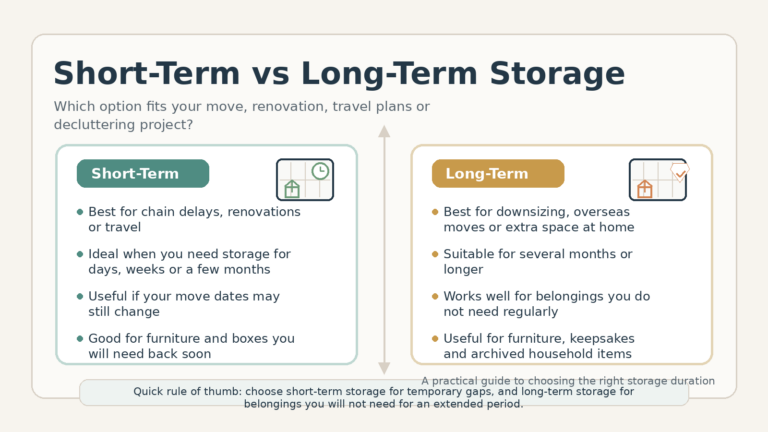
Short-term storage is usually suitable for temporary gaps, such as a delayed property chain, renovation work or a period of travel. Long-term storage is often more appropriate when you do not expect to need certain belongings for several months or longer.
The right choice depends on your timescale, the items you are storing and how easily you may need to retrieve them. Our household storage in Edinburgh can be tailored around both planned and unexpected changes to your moving schedule.
What is the difference between short-term and long-term storage?
The main difference is how long you expect your belongings to remain in storage.
Short-term storage generally covers a temporary period lasting from a few days to several weeks or months. It offers flexibility when your belongings need a safe place while you complete a move, finish building work or wait for your next accommodation.
Long-term storage is intended for belongings that will not be needed for an extended period. This may include furniture kept during an overseas assignment, possessions inherited from a relative or items that no longer fit comfortably in your home.
There is not always a fixed point at which short-term storage becomes long-term storage. Your provider’s terms, billing arrangements and access process may vary, so it is worth discussing your likely duration before committing.
When does short-term storage make sense?
Short-term storage works well when you have a clear temporary need but cannot yet confirm the exact end date.
Common situations include:
- A property chain has been delayed or broken.
- Your sale completes before your new home is ready.
- Renovation work is making rooms difficult to use.
- You are travelling between tenancies or move dates.
- You want to declutter before marketing your property.
- A new-build completion date has changed.
- You are combining two households and need time to organise your belongings.
For busy professionals, short-term storage can also reduce pressure around moving day. Instead of trying to move everything directly from one property to another, selected items can be collected and stored until your new home is ready.
Storage during a renovation
Furniture and personal possessions can restrict access for tradespeople and may be exposed to dust, paint or accidental damage.
Temporary storage gives contractors more working space and allows you to clear one or more rooms properly. It can be particularly useful when flooring, plastering or structural work is planned.
Think carefully about the likely project duration. Renovations often take longer than expected, so choose an arrangement that can be extended without creating unnecessary disruption.
Storage during a property-chain delay
A chain delay can leave you needing to vacate one home before you can enter the next. Short-term storage provides a practical buffer between the two dates.
Your belongings can be collected as part of your removal, placed into storage and delivered when you receive your keys. This avoids having to arrange several separate collections or rely on unsuitable temporary space.
Storage while travelling
Storage can be useful if you are going abroad, taking a career break or spending time between properties.
Before choosing a service, consider whether you will need access while you are away. Containerised storage is often well suited to belongings that can remain securely stored until a planned redelivery, rather than items you expect to collect regularly.
When is long-term storage the better choice?
Long-term storage is more suitable when there is no immediate plan to return your belongings or when keeping them at home would take up valuable space.
It may be appropriate when:
- You are relocating elsewhere in the UK or overseas.
- Your new property is smaller than your previous home.
- You are keeping furniture for a future move.
- You have inherited belongings that need to be sorted gradually.
- You need to store seasonal possessions.
- You are preserving important personal or family items.
- You are creating more usable space at home without disposing of belongings.
Long-term storage solutions for home buyers can provide breathing room after completion. You do not have to decide the future of every item during an already demanding move.
However, long-term storage should not become a place for forgotten possessions. Review what you are storing before collection and consider whether each item is valuable, useful or personally significant enough to justify keeping.
Short-term or long-term storage: what do you require?
Use the following steps to assess your needs.
- Estimate the likely duration. Decide whether you expect to store your belongings for days, weeks, months or longer.
- Identify the reason for storage. A chain delay has a different end point from an open-ended relocation.
- List what you are storing. Note large furniture, fragile pieces, documents and items that need additional preparation.
- Consider how often you need access. Some storage arrangements are designed around collection and redelivery rather than frequent individual visits.
- Check how flexible your dates need to be. Ask what happens if you need to extend or shorten the storage period.
- Compare the full service. Consider collection, loading, storage, protection and return delivery rather than looking only at the weekly or monthly rate.
If your end date is uncertain, explain this when requesting a quotation. A suitable storage plan should accommodate realistic changes without forcing you to rush important decisions.
Short-term versus long-term storage at a glance
| Consideration | Short-term storage | Long-term storage |
|---|---|---|
| Typical purpose | Temporary gap or disruption | Extended space or relocation need |
| Common scenarios | Chains, renovations, travel and moving dates | Downsizing, overseas moves and retained furniture |
| Timescale | Days, weeks or several months | Several months or longer |
| Flexibility | Useful when dates may change | Better for belongings not needed regularly |
| Access | Depends on the storage arrangement | Usually planned less frequently |
| Packing | Secure packing remains important | Extra preparation is advisable for prolonged storage |
| Cost planning | Focus on flexibility and collection costs | Consider the total cost over the full duration |
What items suit short-term storage?
Short-term storage can accommodate most normal household possessions, provided they are packed and protected correctly.
Typical items include:
- Sofas, tables, beds and other furniture
- Boxes of clothes, books and kitchenware
- Home-office equipment
- Pictures, mirrors and ornaments
- Appliances that have been cleaned and prepared
- Seasonal items
- Belongings removed temporarily during renovation work
Keep daily essentials, medication, important documents and anything you may need unexpectedly with you.
What items suit long-term storage?
Long-term storage is often used for durable belongings that are valuable enough to retain but are not needed in daily life.
These may include:
- Good-quality furniture
- Family possessions and keepsakes
- Archived paperwork
- Seasonal sports equipment
- Carefully packed books and collections
- Furnishings intended for a future property
- Business equipment not currently in use
Long-term storage requires more careful preparation. Upholstery should be clean and dry, appliances should be emptied, and fragile belongings should be wrapped with suitable protective materials.
Our forthcoming guide, Packing for Storage: Moisture, Mould and Furniture Protection, will cover the preparation process in more detail.
How do storage costs compare?
Storage costs depend on more than the number of weeks or months involved.
A quotation may be affected by:
- The volume of belongings
- The duration of storage
- Collection and delivery requirements
- Access at each property
- Packing support
- Specialist or fragile items
- The number of containers or storage vaults required
- Whether your dates are fixed or flexible
Short-term storage may have a lower total cost because the duration is shorter. However, collection, handling and redelivery still need to be considered.
Longer arrangements may offer a more efficient rate over time, but the total commitment will usually be greater. Removing items you no longer need before collection can reduce the space required and avoid paying to store belongings with little practical or personal value.
A clear quotation should explain the relevant services and charges so that you can compare the complete arrangement.
How can you keep belongings safe in storage?
Good preparation is important regardless of duration.
Before your belongings are collected:
- Make sure furniture, fabrics and appliances are clean and completely dry.
- Empty and defrost fridges and freezers.
- Remove batteries from suitable electrical items.
- Use strong boxes that can be closed securely.
- Wrap fragile pieces individually.
- Label boxes clearly by room and general contents.
- Create an inventory of stored belongings.
- Keep valuables and essential documents separately where appropriate.
Avoid packing damp textiles or sealing moisture inside appliances. Even a small amount of moisture can cause odours or damage over time.
Ask how your belongings will be handled, loaded and stored. Containerised storage can reduce unnecessary handling because possessions are loaded into storage containers and retained there until they are required for delivery.
What should you look for in an Edinburgh storage facility?
Look beyond the size of the available storage space. The handling process and service arrangements matter just as much.
Ask potential providers about:
- Whether the facility is secure and monitored
- How belongings are protected during collection and loading
- Whether storage areas are clean and dry
- How access or redelivery is arranged
- What packing support is available
- What happens if your dates change
- How the quotation is calculated
- What insurance arrangements apply
- Which items cannot be accepted
You should also explain any access restrictions at your property. Edinburgh homes can involve narrow stairways, shared entrances, controlled parking areas and limited loading space. Discussing these details early helps the team plan the correct vehicle, equipment and schedule.
Common storage misconceptions
“Short-term storage is only for moving house”
Moving is a common reason, but temporary storage can also support renovations, travel, decluttering and changes in household circumstances.
“Long-term storage means losing access to your belongings”
Access arrangements vary by provider and storage method. Ask how much notice is required and whether items can be retrieved individually or need to be returned as a complete load.
“Anything can go into storage”
Storage providers normally restrict hazardous, perishable, illegal or unsuitable items. Always confirm what can and cannot be accepted before packing.
“The cheapest weekly rate is always the lowest-cost option”
A low storage rate may not include collection, handling, packing or redelivery. Compare the full service and make sure it suits your timetable and access requirements.
A practical storage checklist
Before deciding, confirm:
- Why you need storage
- Your earliest possible start date
- Your estimated end date
- Whether the end date may change
- Which items need to be stored
- Which belongings you will keep with you
- Whether you need packing assistance
- Whether you expect to require access
- The collection and return addresses
- Any parking, stair or entry restrictions
- The full cost of collection, storage and redelivery
This approach turns storage into a planned part of your move rather than a last-minute reaction.
Choosing the right storage option
Choose short-term storage when your need is temporary, your plans are still developing or you expect your belongings to be returned within a relatively short period.
Choose long-term storage when you need reliable space for several months or longer and do not expect regular access to the items.
Some situations begin as short term and become longer term. A renovation may overrun, a move abroad may be extended or your next property may have less space than expected. The most useful arrangement is therefore one that combines secure storage with clear, flexible terms.
MoveStore can collect your belongings, load them carefully into sealed storage containers and keep them in our secure, monitored facility until you are ready for delivery. Explore our household storage options in Edinburgh and request a no-obligation quotation tailored to your timescale.
Frequently asked questions
How long does short-term storage usually last?
Short-term storage commonly lasts from a few days to several weeks or months. There is no universal definition, so check the provider’s minimum term, billing period and extension arrangements.
Can I extend short-term storage if my plans change?
This will depend on availability and the provider’s terms. Tell the storage company as soon as possible if a completion date, renovation or journey is likely to take longer than planned.
Is long-term storage suitable for furniture?
Yes, provided the furniture is clean, dry and protected correctly. Upholstered, wooden and fragile pieces may require different packing materials and handling methods.
Can a removals company collect items for storage?
Many removals and storage companies can collect, load, store and return belongings as one coordinated service. This can reduce handling and simplify arrangements when you have limited time.
Do I need access to my belongings while they are stored?
That depends on what you are storing and how long it will remain there. Keep essentials and anything you may need unexpectedly outside storage, and confirm the access process before booking.
Should I choose storage before my moving date is confirmed?
It is sensible to discuss storage early when your dates may not align. Planning a backup option can reduce pressure if a property chain, renovation or completion date changes.